
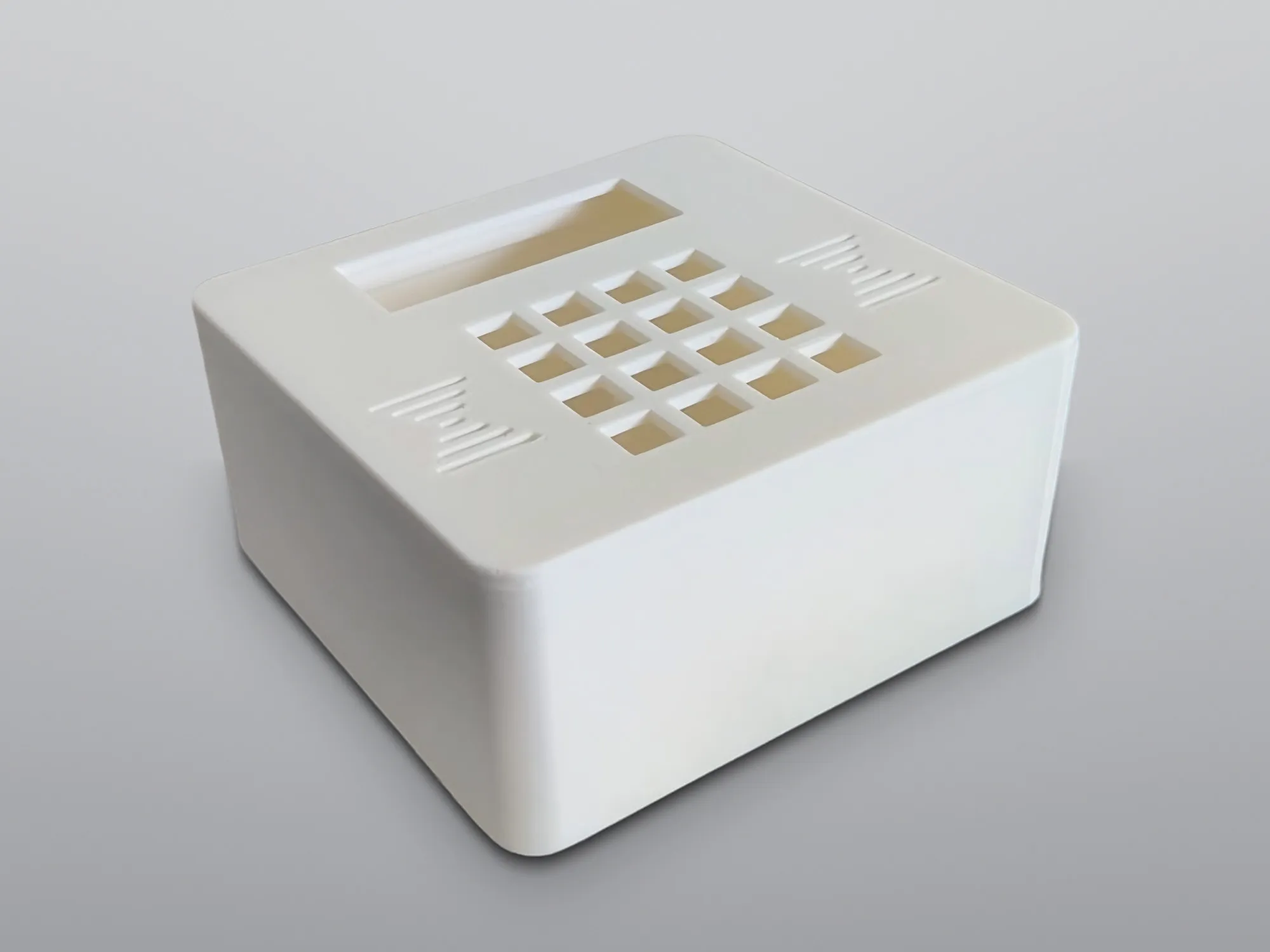
A common problem with new enclosures: the prototype is printed in PLA because it is cheap, the production part is moulded in ABS by a different vendor, and the two never quite match. Snap-fits that worked on the print are too stiff on the moulded part, or the screw bosses crack, and the mould has to be modified.
ABS removes one of those variables. We print it on our 12 FDM printers and mould it on our 250-tonne Haitian MA 2500 press, in the same factory in Savali, Sangli. Your prototype and your production part are the same polymer family, made from the same CAD file, checked by the same engineer.
Why ABS for enclosures and housings
ABS (acrylonitrile butadiene styrene) is the default plastic for electronic enclosures, appliance housings and covers, and for good reasons:
- Heat. It holds its shape to roughly 95–105 °C, well above PLA, so it survives inside a warm control panel or a vehicle.
- Toughness. The rubbery butadiene phase gives it decent impact strength; it takes a drop better than PLA.
- Screws and inserts. It holds self-tapping screws and heat-set brass inserts well.
- Finish. It paints, glues and polishes well. Moulded ABS gives a clean, product-quality surface.
- Low moulding shrinkage. Typically 0.4–0.7%, so moulded ABS parts hold dimensions better than PP or HDPE.
ABS 3D printed vs ABS moulded
| FDM-printed ABS | Injection-moulded ABS | |
|---|---|---|
| Best quantity | 1 to a few hundred | Hundreds to many thousands |
| Upfront cost | None | Mould: quoted after a free DFM check |
| Price per part | ≈ ₹4.05/g + ₹18.75, nearly flat with quantity | Quoted per part, falls with quantity |
| Strength | Weaker between layers | Solid, close to equal in all directions |
| Surface | Visible layer lines; can be sanded and painted | Smooth or textured from the mould |
| Design changes | Change the file, reprint | Modify the steel |
The practical route is to print first, test the fit and assembly, freeze the design, and only then pay for the mould. The break-even guide shows how to find the quantity where moulding becomes cheaper.
When to choose ABS, and when not to
Choose ABS when:
- the part is an enclosure, housing, cover or keypad that must look like a finished product;
- it will sit somewhere warm — a panel, a machine, a vehicle;
- it will be painted, glued, or assembled with screws or inserts;
- you want to prototype and mass-produce in the same material.
Avoid ABS when:
- the part lives outdoors in direct sun without paint (it yellows and turns brittle);
- it touches petrol, solvents, or strong cleaning chemicals — PP or HDPE resist these far better;
- it needs a living hinge — that is a PP job;
- you need tight dimensional accuracy on a large flat printed part, where ABS warps more than PLA or PETG.
ABS compared with PP for moulded parts
| ABS | PP | |
|---|---|---|
| Surface finish | Glossy, crisp, paints well | Slightly waxy; hard to paint or glue |
| Stiffness | Higher | Lower, more flexible |
| Chemical resistance | Moderate | Very good |
| Living hinges | No | Yes |
| Typical moulding shrinkage | ~0.4–0.7% | ~1–2.5% |
What ABS printing costs
At about ₹4.05 per gram plus ₹18.75 handling per part (excluding GST), indicative examples from our quote formula are: a 50 × 30 × 20 mm bracket for ₹93, a 100 × 60 × 30 mm enclosure for ₹214, and a 163 × 163 × 62 mm IoT box for about ₹1,109. ABS costs a little more than PLA because it is slower to print reliably. Final prices depend on your actual file.
Designing an ABS part for both processes
If you plan to mould later, design for moulding from the start, even for the printed prototype:
- keep walls even, roughly 1.5–3 mm for small parts;
- add 1–2° draft on faces parallel to the mould opening;
- use ribs instead of thick sections;
- design screw bosses with a wall about 60% of the nominal wall, tied to a side wall with a rib.
A printed part does not need draft, but adding it now means the prototype you approve is the part the mould will make. Our DFM checklist covers each rule.
Next step
Send a STEP file with the expected annual quantity. We will tell you whether to print, mould, or print now and mould later, and quote accordingly. Call or WhatsApp +91 93568 71008.