
The most common question we hear about moulding is “how much will the mould cost?”, usually asked with nothing more than a photo. The honest answer is that the mould is not priced by the part’s weight or by the quantity you need. It is priced by how much machining, fitting and engineering it takes to make the steel produce that part reliably, and two parts that look similar can need very different tools.
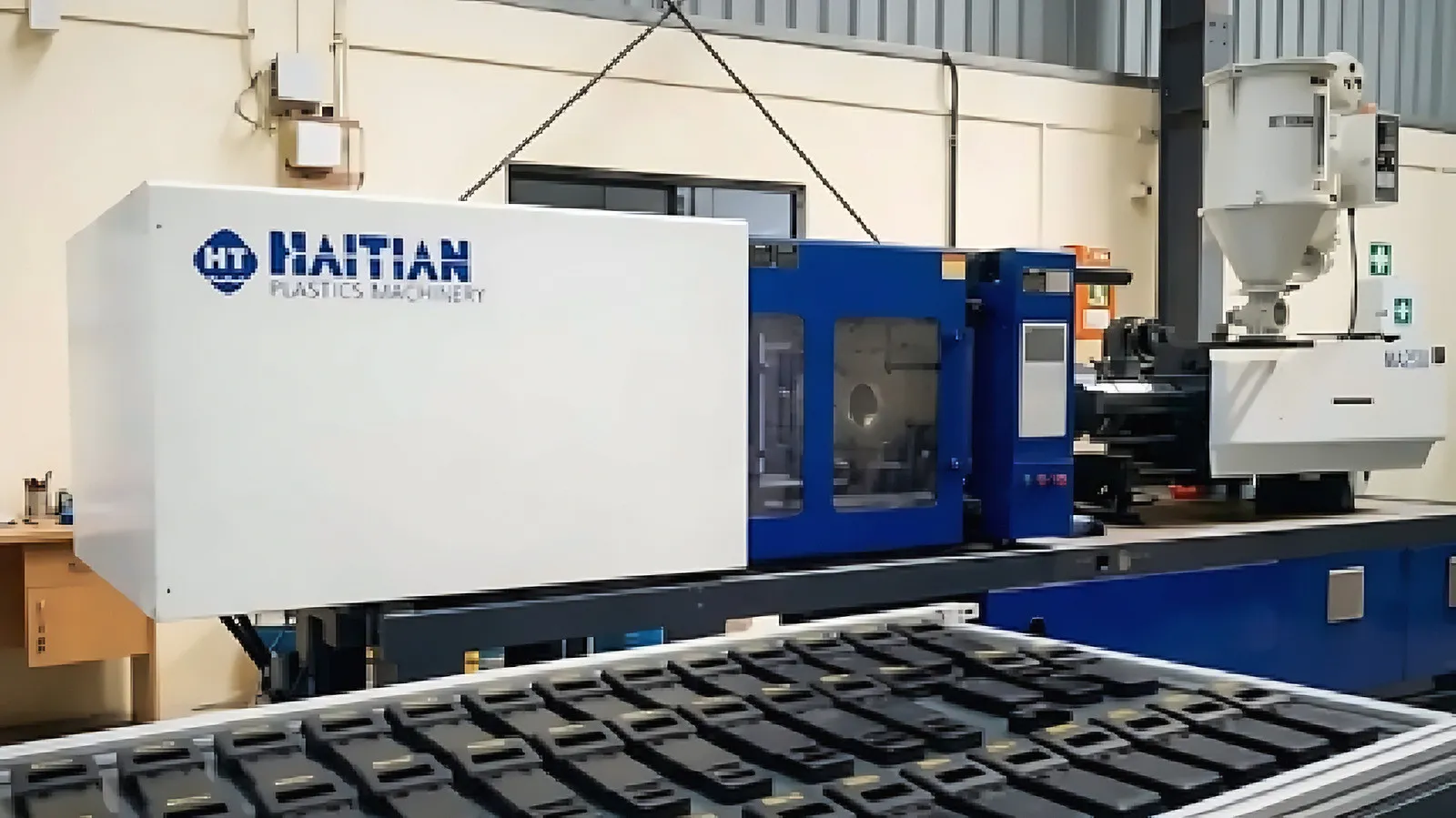
AURO3D runs moulds on its own 250-tonne Haitian MA 2500 servo-hydraulic press in Savali, Sangli, and arranges mould design and build for customers after a DFM review. This guide explains the cost drivers we look at, so you can make the decisions that cut the price before the steel is cut. We do not publish rupee figures here because every mould is quoted individually.
Where the money goes in a mould
A mould is several systems working together. Each one adds machining, material or fitting time:
| Part of the mould | What it does | What makes it expensive |
|---|---|---|
| Core and cavity inserts | Form the shape of the part | Part size, complexity, steel grade, polish or texture |
| Mould base | Holds the inserts, guides the halves, mounts on the press | Size, custom vs standard plates |
| Feed system (sprue, runners, gates) | Carries molten plastic to the cavities | Number of cavities, hot runner vs cold runner |
| Cooling channels | Control cycle time and warpage | Number and complexity of circuits |
| Ejection | Pushes the part off the core | Number of pins, sleeves or stripper plates |
| Side actions (sliders, lifters) | Release undercuts | Each one is a separate moving mechanism |
The core and cavity, and any side actions, are usually where most of the toolmaker’s hours go. That is where design decisions have the most effect.
The cost drivers, one by one
1. Part size and projected area
A bigger part needs bigger inserts, a bigger mould base, more steel and longer machining. Projected area (the part’s footprint seen from the direction the mould opens) also sets the clamping force needed, which decides which press can run it. As a rough industry rule of thumb, PP, HDPE and ABS need somewhere around 2–5 tonnes of clamp force per square inch of projected area, depending on wall thickness and flow length. We check this for every part against our 250-tonne press.
2. Number of cavities
A two-cavity mould makes two parts per cycle. It does not cost twice as much as a single cavity, because the base and ejection system are shared, but it costs clearly more. The trade-off is press time:
| Cavities | Parts per hour at an illustrative 35-second cycle | Press hours for 10,000 parts |
|---|---|---|
| 1 | about 103 | about 97 |
| 2 | about 206 | about 49 |
| 4 | about 411 | about 24 |
The 35-second cycle is an illustrative assumption for the arithmetic; real cycle time depends on wall thickness, material and cooling. More cavities pay off when annual volume is high enough that saved press hours outweigh the extra tooling. For a new product, that is rarely true in year one.
3. Steel grade, or aluminium
The material of the core and cavity sets both the price and the life of the mould.
| Tool material | Typical use | Typical life (general industry ranges) | Relative cost |
|---|---|---|---|
| Aluminium (e.g. 7075) | Prototype and bridge tools, short runs | Typically thousands to tens of thousands of shots | Lowest |
| Pre-hardened P20 | General production moulds | Typically a few lakh shots | Medium |
| Pre-hardened 718 / 718H | Production moulds needing better polish | Typically a few lakh shots or more | Medium |
| Hardened H13 | High-volume moulds, longer runs | Typically 5 lakh to 10 lakh shots or more | High |
| Stainless S136 (hardened) | Mirror polish, corrosive materials, clear parts | Typically 10 lakh shots or more | Highest |
These ranges assume unfilled plastics and proper maintenance. Glass-filled materials wear moulds much faster. For PP, HDPE and ABS at the volumes most of our customers need, a pre-hardened steel is usually the sensible choice; paying for hardened steel to make a few thousand parts a year is money in the wrong place.
4. Side actions: sliders and lifters
Any feature that stops the part coming straight off the core (a side hole, a snap hook, an undercut clip, an external thread) needs a side action. Each slider or lifter must be designed, machined, hardened, fitted, cooled and timed. A part with four undercuts can easily need a tool that is more complex than the rest of the mould combined.
This is the largest saving most parts offer. Many undercuts can be removed by moving a hole, turning a clip into a pass-through snap (a shut-off formed by the core and cavity), or splitting the part.
5. Hot runner vs cold runner
A cold runner is a channel of plastic that solidifies with the part and is cut off. It is simple and cheap to build; the runner is scrap or regrind. A hot runner keeps the plastic molten up to the gate, saving material and often cycle time, but adds a manifold, nozzles and a temperature controller to the mould cost and to maintenance. For single- and two-cavity moulds in PP, HDPE or ABS at moderate volumes, a cold runner is usually the right choice.
6. Surface finish and texture
A plain machined or lightly stoned finish costs least. High polish (for example SPI A-grade finishes or a mirror finish on S136) needs hours of hand polishing. Textures (VDI or similar grades) are added by EDM or chemical etching. Specify the finish only on faces the customer sees; an inner face polished to a mirror is money no one will notice.
7. Tolerances
Most plastic parts work with general moulding tolerances. Tight tolerances on many dimensions push up mould cost because they need more precise machining, more trial rounds and steel adjustments after the first shots. Mark the few dimensions that really matter (mating faces, bearing seats, snap-fit engagement) and leave the rest at general tolerance.
8. Mould base: standard or custom
Standard catalogue mould bases are faster and usually cheaper than plates machined from scratch, and spare parts are easier to find. Ask which one is quoted.
9. Design changes after the steel is cut
A change after machining can mean welding, re-machining and re-polishing, or a new insert. A well-run project leaves dimensions that might change “steel-safe” (with steel left to remove rather than add), but the best way to avoid change costs is to finish testing before you order. Our DFM checklist and break-even guide cover how to test with 3D prints first.
How to reduce mould cost before you order
In rough order of impact:
- Do a DFM review. Even walls, draft on vertical faces, ribs instead of thick sections and generous radii make a mould simpler and the parts better. We include a DFM review with every moulding enquiry.
- Remove or simplify undercuts. Each side action you design out is one less mechanism to build and maintain.
- Start with a single cavity. Prove the part and the market, then add cavities when volume justifies it.
- Consider a family mould if you need two or three small parts of the same material and colour in similar quantities, such as a box and its lid. One mould is cheaper than two. Avoid it when the parts need different volumes or very different wall thicknesses, as they will not fill evenly.
- Match the steel to the volume. Do not buy a million-shot tool for a few thousand parts a year.
- Specify finish and tolerance only where needed.
- Freeze the design with 3D prints. We print the exact CAD the mould will be cut from, so fit problems show up for a few hundred rupees instead of in steel.
What to ask a toolmaker
Two quotes are only comparable when they answer the same questions. Ask for these in writing:
- Steel grade for the core, the cavity and the mould base; hardness if hardened.
- Number of cavities, and whether it is a family mould.
- Number and type of side actions (sliders, lifters, unscrewing cores).
- Runner type (hot or cold), gate type and gate position.
- Cooling layout, and the expected cycle time.
- Surface finish or texture, face by face.
- Number of trial (T1, T2…) rounds included, and who supplies the material for trials.
- Which modifications are included after T1, and how extra changes are charged.
- Expected shot life and any warranty.
- Who owns the mould and the mould design files.
- Delivery time to first samples, and the payment schedule.
- The press it is designed for: clamp tonnage, tie-bar spacing, mould height and ejector layout must match the moulder’s machine.
The last point catches many buyers out. A mould built for a different press may need adapter plates or may not fit at all.
Mould ownership, storage and maintenance
Normally the customer who pays for the mould owns it. Put that in the purchase order, together with where the mould will be kept and how it can be moved to another moulder if needed. AURO3D agrees these terms in writing before the mould is built.
A mould is a precision tool and needs care to reach its expected life:
- After each run: clean the parting line and vents, dry the cooling channels, and apply rust preventive before storage. Sangli’s monsoon humidity is hard on bare steel.
- Periodically: inspect and replace worn ejector pins, check slides and lifters for wear, and clean scale from cooling channels. Preventive maintenance is typically scheduled by shot count.
- Before a long gap: store the mould closed, protected and indoors.
Most moulds that fail early fail from neglect, not from reaching their design life.
Running your mould at AURO3D
We mould on a 250-tonne Haitian MA 2500 (Mars series, servo-hydraulic) in our factory at Kanadwadi, Savali, Sangli. We regularly run PP, HDPE and ABS; other materials on request if the mould and press suit them. Before a mould is designed we check projected area against clamp force and the mould size against the press. We confirm the mould lead time in your written quote.
Because our 3D printers are in the same building, the part is printed and approved before steel is cut, and first-off moulded parts are checked against the same CAD.
What to send for a mould quote
Send a STEP file (or a physical sample, which we can reverse-engineer), the material, expected annual quantity and batch size, any cosmetic faces and critical dimensions. We will come back with a DFM review, a mould recommendation (cavities, steel, side actions) and the break-even against 3D printing, so you know whether a mould is the right buy at all.