
Some parts have a hard life. An irrigation fitting gets stepped on in a sugarcane field, a protective cap is thrown into a bin with steel parts, a handle on agricultural equipment is left in the rain for years. Brittle plastics crack, and metal rusts or costs too much.
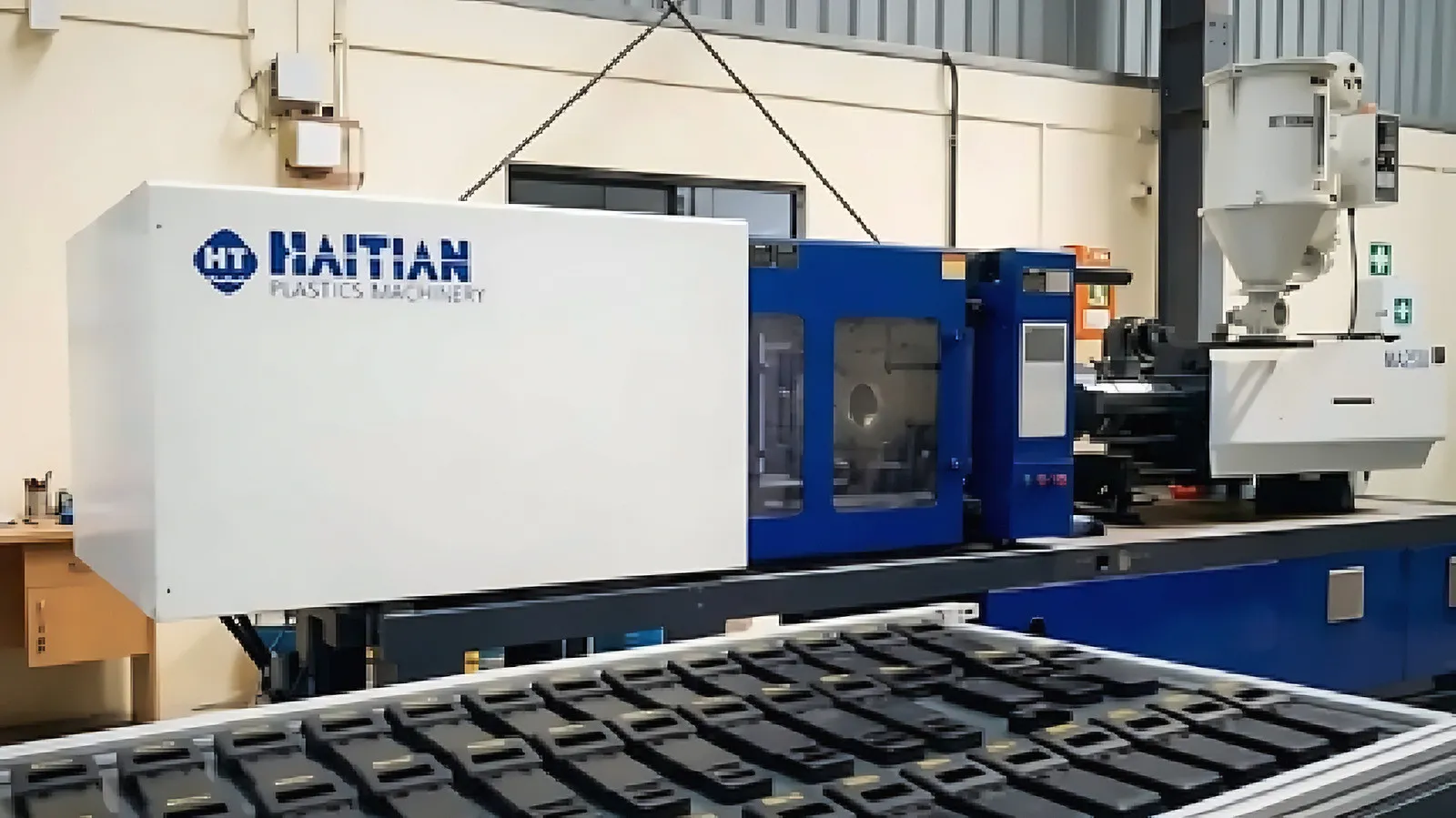
HDPE is made for that kind of use. It bends rather than breaking, shrugs off water and most chemicals, and stays tough in the cold. We mould it on our 250-tonne Haitian MA 2500 press in Savali, Sangli, close to the agricultural and engineering industries of the Sangli–Kolhapur belt.
Why choose HDPE
- Impact toughness. HDPE is one of the toughest common plastics, and it stays tough at low temperatures where many others become brittle.
- Chemical and moisture resistance. It handles water, fertilisers, most acids and alkalis, and detergents. It absorbs almost no water.
- Low friction. Its waxy surface slides easily, useful for wear strips and guides.
- Low cost. Like PP, it is among the cheaper plastics by raw material.
- Forgiving in use. Parts dent rather than shatter, which matters for anything handled roughly.
The limitations
- High, uneven shrinkage. Typically 1.5–3%. Large flat parts and uneven walls warp. HDPE is not a precision material.
- Low stiffness. It flexes more than PP or ABS. Thin, long parts need ribs or a stiffer material.
- Heat. It softens at lower temperatures than PP; keep it away from hot surfaces.
- Hard to paint, print or glue. Like PP, it has low surface energy. Use moulded-in colour.
- UV. Needs a UV-stabilised or black grade for long outdoor life.
When to choose HDPE, and when not to
Choose HDPE when:
- the part will be dropped, hit or stepped on;
- it is used outdoors, in water, or with agricultural chemicals;
- it works in cold conditions;
- it slides against other parts and must wear slowly;
- cost per part matters more than appearance.
Do not choose HDPE when the part needs tight tolerances, a premium glossy surface, paint or adhesive, high stiffness in thin sections, or heat resistance. ABS suits precise, good-looking housings; PP suits stiffer parts and hinges.
HDPE compared with PP
| HDPE | PP | |
|---|---|---|
| Density (typical) | ~0.94–0.97 g/cm³ | ~0.90–0.91 g/cm³ |
| Impact toughness, especially cold | Excellent | Good (copolymer); homopolymer brittle in cold |
| Stiffness | Lower | Higher |
| Heat resistance | Lower | Higher |
| Living hinges | Limited | Excellent |
| Typical moulding shrinkage | ~1.5–3% | ~1–2.5% |
| Surface feel | Waxy, slippery | Harder, slightly waxy |
Values are typical ranges from general material data and vary by grade.
Designing an HDPE part
- Keep walls uniform. This is the single most important rule for HDPE. Core out thick sections.
- Draft generously, at least 1–2°, more on deep parts and textured faces.
- Use ribs for stiffness, around half the wall thickness, to avoid sink marks on the visible face.
- Do not over-specify tolerances. Allow for shrinkage, and agree critical dimensions before the mould is built.
- Place the gate so material flows evenly; this reduces warping.
Our DFM checklist explains each rule, and we review them free on every moulding enquiry.
Typical HDPE parts for the Sangli–Kolhapur belt
Agriculture and agro-processing are a large part of the economy around Sangli, and many of the plastic parts that industry uses suit HDPE: irrigation and drip fittings, end caps for pipes and tubes, protective covers for equipment, handles and grips, spacers and small crates. Engineering firms also use HDPE for low-friction wear strips and guides on conveyors. If you buy any of these from far away or in metal today, an HDPE moulding may be cheaper at volume.
Cost and quantities
We quote the mould cost and the moulded HDPE part price individually for each part. Because tooling is a fixed cost, HDPE moulding makes sense once you need hundreds or thousands of identical parts. For fewer, a 3D-printed batch is usually cheaper. We work out the crossover with you.
Next step
Send a STEP file or a sample, the annual quantity, colour and where the part is used. If you only have a worn part, we can reverse-engineer it first. Call or WhatsApp +91 93568 71008, or visit the factory at Kanadwadi, Savali.