
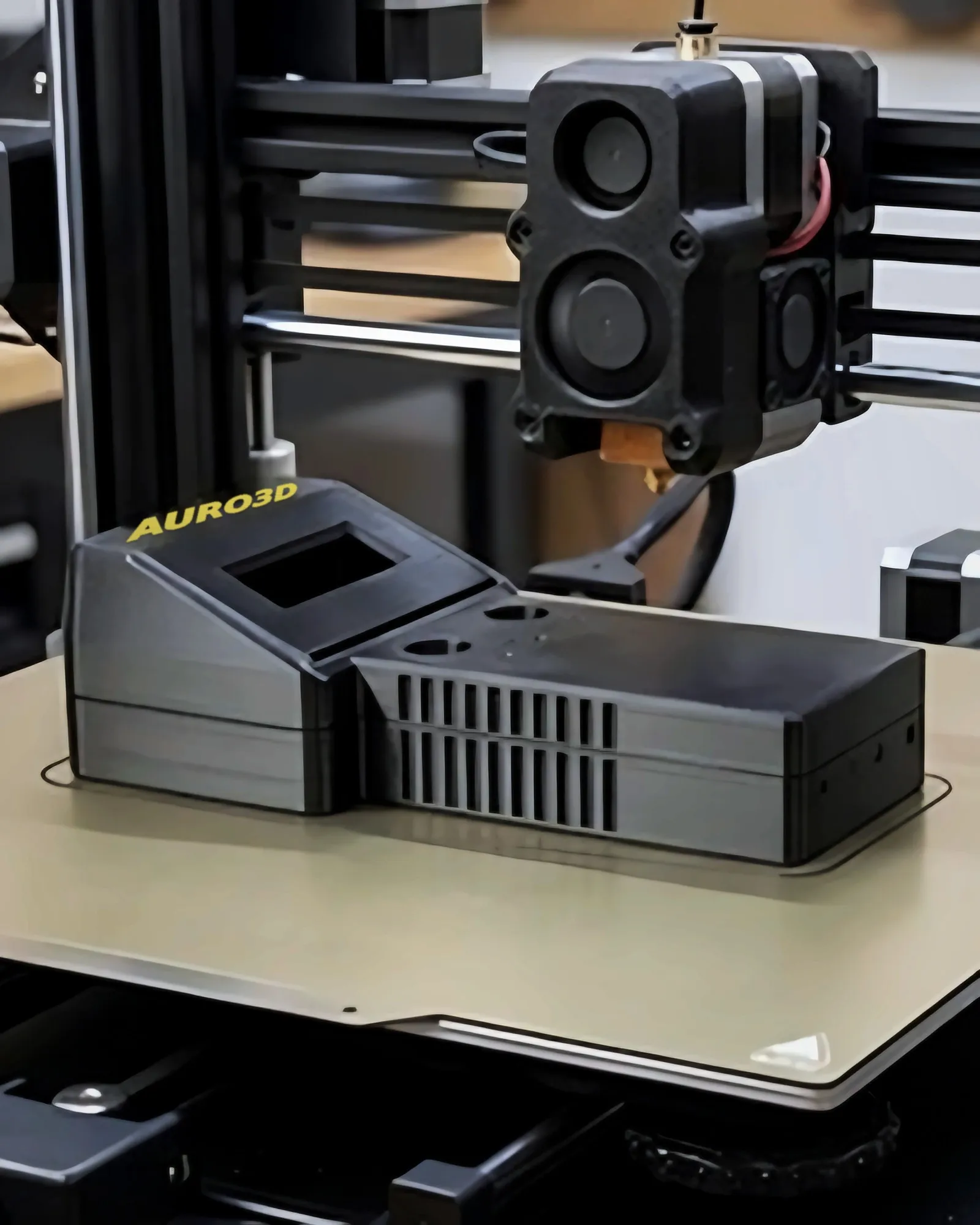
Many buyers ask for PLA because it is the material they have heard of, then find the part cracks when it is screwed down too hard or sags when it sits in the sun. Others ask for ABS because it sounds industrial, then pay more for a part that did not need it.
For a large share of everyday functional parts — brackets, clips, cable guides, sensor mounts, covers and guards — PETG is the better answer. On our 12 FDM printers in Sangli it costs the same as PLA, and it survives far more of what real use throws at a part.
What PETG is
PETG is a glycol-modified version of PET, the plastic used in drinking-water bottles. The glycol modification makes it print without crystallising, which gives a part that is clear-ish, tough and slightly flexible.
In practical terms:
- It bends before it breaks. A PETG clip flexes; a PLA clip snaps.
- Layers bond well. Parts are less likely to split along a layer line than PLA or ABS.
- It handles more heat than PLA, typically up to around 70 °C in use.
- It shrugs off water and many everyday chemicals, such as dilute acids, alkalis and oils. Strong solvents are another matter.
- It barely warps, so large parts stay flat without the care ABS needs.
Where PETG falls short
- Stringing and surface. PETG can leave fine strings and a slightly less crisp surface than PLA. We tune for this, but fine text and sharp edges are better in PLA or resin.
- Scratches. The surface is softer than PLA and scuffs more easily.
- Painting. Paint adhesion is weaker than on PLA or ABS; it needs a suitable primer.
- Wear. For gears, bushes and sliding parts, Nylon wears far better.
- High heat. Above about 70 °C, step up to ABS or Nylon.
When to choose PETG, and when not to
Choose PETG when:
- the part is functional and must survive being screwed down, knocked or flexed;
- it lives outdoors, in a damp shed, or near water;
- it is a jig, fixture, guard or cover on a machine that runs at normal ambient temperature;
- you want toughness without paying the ABS or Nylon premium.
Do not choose PETG when the part needs a perfect painted finish (use PLA or ABS), runs hot (ABS or Nylon), slides or rotates against another part (Nylon), or must hold very fine detail (resin).
PETG compared with PLA and ABS
| PETG | PLA | ABS | |
|---|---|---|---|
| Softens from (typical) | ~75–80 °C | ~55–60 °C | ~95–105 °C |
| Impact toughness | Good | Low | Good |
| Warping when printing | Low | Very low | High |
| Moisture / outdoor use | Good | Poor | Fair (yellows in sun) |
| Painting | Fair (needs primer) | Very good | Very good |
| Indicative FDM price | ≈ ₹3.13/g + ₹18.75 | ≈ ₹3.13/g + ₹18.75 | ≈ ₹4.05/g + ₹18.75 |
Temperatures are typical published values for the base polymers; actual figures vary by brand and grade.
What PETG parts cost
Because PETG and PLA share the same rate on our formula, the same examples apply. Excluding GST and indicative only: a 50 × 30 × 20 mm bracket with 3 mm walls is about ₹76, a 100 × 60 × 30 mm enclosure with 2 mm walls about ₹170, and a 163 × 163 × 62 mm IoT box about ₹862. The equivalent ABS enclosure is about ₹214, so PETG saves roughly 20% where its heat limit is acceptable. The final price depends on your actual file.
Design tips for PETG
- Give clearances a little more room than in PLA, roughly 0.3–0.5 mm for sliding fits, as PETG is slightly stickier.
- Use it for snap-fits with generous root radii; PETG flexes well but sharp corners still crack.
- Avoid tiny, dense text on visible faces; emboss rather than engrave if you need lettering.
- Tell us the load direction, so we orient layers to carry it.
Getting PETG parts made
Send a STEP or STL file, quantity, colour and a line on where the part is used. If PETG is not the best fit we will say so and suggest the alternative. For batches of tens to a few hundred identical parts, see low-volume production. Call or WhatsApp +91 93568 71008.