
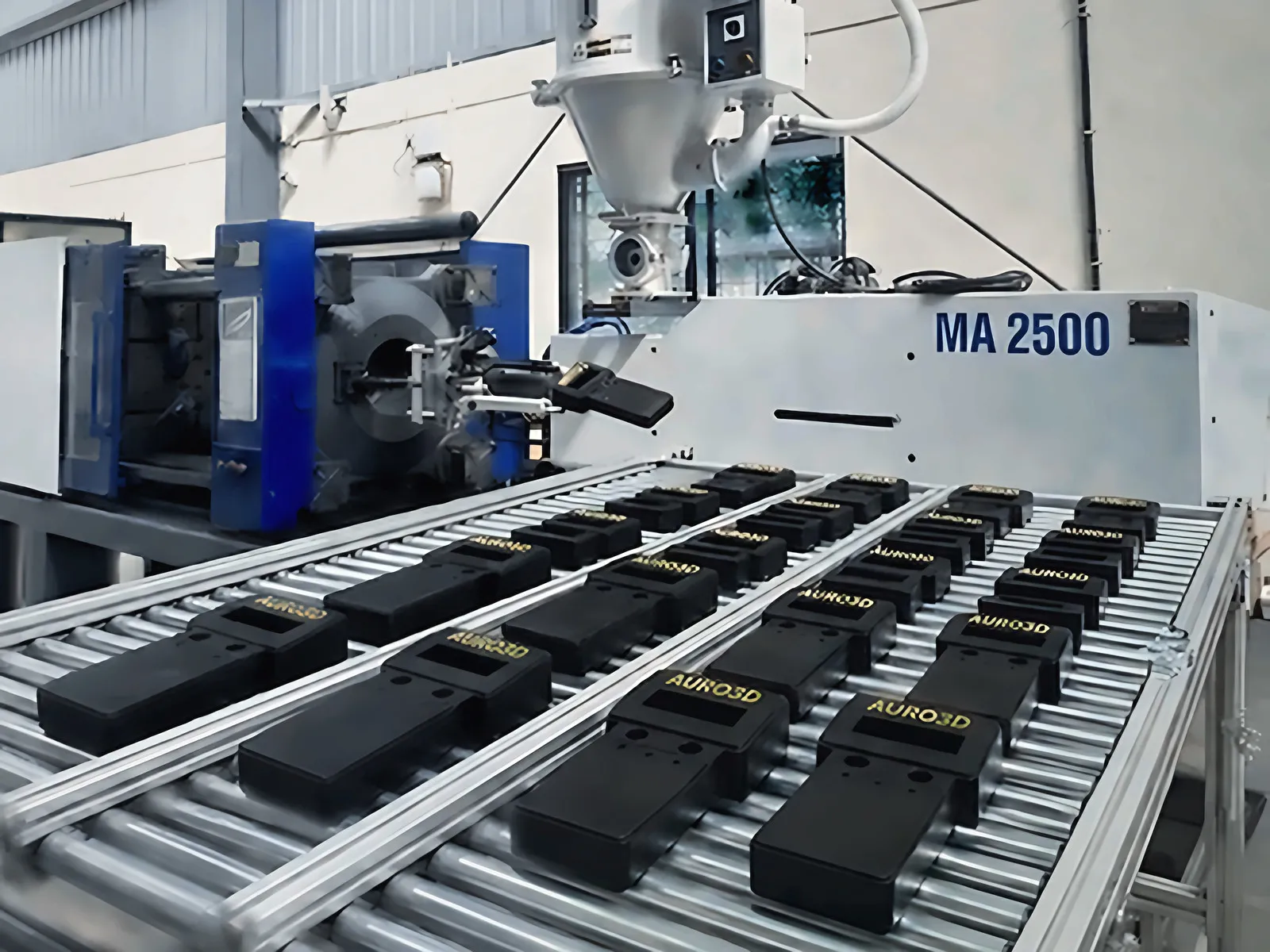
Every product team reaches the same question: we have a part that works, we need more of them, should we keep printing or pay for a mould? Get it wrong one way and you pay lakhs for steel that sits unused when the design changes. Get it wrong the other way and you pay ₹200 a part for something that could cost a fraction of that.
AURO3D runs 12 FDM printers, two resin printers and a 250-tonne Haitian injection moulding press in the same factory in Sangli, so we have no reason to push you towards either process. This guide shows the arithmetic we use, worked through for one real part.
The break-even formula
3D printing has almost no fixed cost but a high price per part. Injection moulding has a large fixed cost (the mould) and a low price per part. Total cost for n parts:
- Printing: n × printed price per part
- Moulding: mould cost + n × moulded price per part
The two lines cross at the break-even quantity:
Break-even quantity = mould cost ÷ (printed price per part − moulded price per part)
Below that quantity, print. Above it, mould, provided the non-cost factors later in this guide also point that way.
The example part
We use a 100 × 60 × 30 mm ABS enclosure with 2 mm walls, about 48 g. It is a typical electronics housing and a part that can sensibly be either printed or moulded.
| Input | Value | Source |
|---|---|---|
| Printed price, FDM ABS | ₹214 per part (exact ₹214.17) | AURO3D’s quote formula, indicative, excl. GST |
| Mould cost | ₹60,000 | Illustrative assumption for this example, not an AURO3D quote |
| Moulded price per part | ₹25 | Illustrative assumption for this example, not an AURO3D quote |
The two moulding figures are round numbers chosen only to show the calculation. Real mould prices vary widely with cavities, side actions, steel and finish; our mould cost guide explains why. AURO3D quotes both the mould and the moulded part price individually for each job.
The printed price is real. Because FDM print time per part does not fall with quantity, our formula gives the same ₹214.17 per part at 1, 50 or 5,000 pieces.
Break-even = ₹60,000 ÷ (₹214.17 − ₹25) = ₹60,000 ÷ ₹189.17 ≈ 318 parts.
Total cost at 50, 500 and 5,000 parts
| Quantity | 3D printed (FDM ABS) | Moulded (illustrative) | Effective cost per moulded part | Cheaper option | Difference |
|---|---|---|---|---|---|
| 50 | ₹10,709 | ₹61,250 | ₹1,225 | Printing | Printing saves ₹50,541 |
| 500 | ₹1,07,086 | ₹72,500 | ₹145 | Moulding | Moulding saves ₹34,586 |
| 5,000 | ₹10,70,863 | ₹1,85,000 | ₹37 | Moulding | Moulding saves ₹8,85,863 |
All figures exclude GST. The printed column is indicative from our formula; the moulded column uses the illustrative mould and part prices above.
Three things to read from this table:
- At 50 parts the mould is absurd. Each moulded part effectively costs ₹1,225 because the steel is spread over so few pieces. Printing costs less than a fifth of that.
- At 500 parts moulding wins, but not by a mile. A saving of about ₹34,600 is real money, but it disappears quickly if the mould costs more than assumed or the design changes once (see sensitivity below).
- At 5,000 parts printing is the wrong process. You would spend over ₹10 lakh, and printing would also tie up a lot of machine time. The enclosure takes about 4.8 printer-hours in ABS, so 5,000 of them is roughly 24,000 printer-hours, or about 2,000 hours on each of our 12 FDM printers. That arithmetic alone rules it out.
Sensitivity: what if the assumptions are wrong?
A break-even figure is only as good as its inputs. Before deciding, flex the numbers that are least certain.
| Scenario (moulding figures illustrative) | Mould cost | Moulded price | Printed price | Break-even |
|---|---|---|---|---|
| Base case | ₹60,000 | ₹25 | ₹214 (ABS) | 318 parts |
| Mould costs double | ₹1,20,000 | ₹25 | ₹214 | 635 parts |
| Moulded part costs ₹40 | ₹60,000 | ₹40 | ₹214 | 345 parts |
| Both of the above | ₹1,20,000 | ₹40 | ₹214 | 689 parts |
| Mould costs half | ₹30,000 | ₹25 | ₹214 | 159 parts |
| Print in PLA instead of ABS | ₹60,000 | ₹25 | ₹170 (PLA) | 414 parts |
The lesson: break-even scales directly with mould cost. Double the mould and you need double the parts. At 500 pieces with a ₹1,20,000 mould, moulding costs ₹1,32,500 against ₹1,07,086 for printing, so the decision flips back to printing.
The moulded part price matters much less, because it is small next to the printed price. Going from ₹25 to ₹40 moved the break-even by only 27 parts.
The last row matters too. If the part works in PLA at ₹170, the gap per part narrows and you need about 100 more parts before the mould pays off.
The part changes the answer
Run the same formula on two other parts from our quote formula, again with illustrative moulding figures:
| Part | Printed (FDM ABS, indicative) | Illustrative mould | Illustrative moulded price | Break-even |
|---|---|---|---|---|
| Small gear, 30 × 30 × 10 mm solid | ₹62 | ₹40,000 | ₹5 | about 696 parts |
| IoT box, 163 × 163 × 62 mm | ₹1,109 | ₹2,50,000 | ₹90 | about 246 parts |
Small, cheap-to-print parts need high volumes before a mould pays off. Large parts that are expensive to print can justify a bigger mould at fewer pieces.
What the formula leaves out
Cost is only one input. These factors often decide the question before the arithmetic does.
| Factor | Favours 3D printing when… | Favours moulding when… |
|---|---|---|
| Design stability | The design may still change | The design is frozen and tested |
| Lead time to first part | You need parts in days | You can wait for the mould |
| Material | PLA, PETG, ABS, Nylon or resin is good enough | You need PP, HDPE or moulded ABS properties |
| Strength | Loads are modest | The part is loaded in every direction (printed parts are weaker between layers) |
| Surface finish | Layer lines are acceptable or will be finished | You need a consistent moulded surface on every part |
| Variants | Each part is customised or there are many versions | One design, many identical copies |
| Cash flow | You cannot tie up money in tooling | You can pay for the mould up front and recover it over a known volume |
| Geometry | Undercuts, internal channels or lattices | Simple, open shapes with draft |
Design stability is the one people underestimate. A mould modification can cost a meaningful share of the mould price and take weeks. If you expect even one more design change, add its likely cost to the mould in the formula and the break-even rises.
Cash flow is the other. The mould is paid before you sell a single part; printed parts are paid batch by batch. A company that needs 1,000 parts a year in batches of 80 may rationally keep printing past the break-even point, just to keep cash free.
The bridge strategy: print first, mould later
The best answer is often not “print or mould” but “print, then mould”. Here is how we run it for our own customers:
- Prove the design with prints. Make 5–20 parts on FDM or resin, fit them, test them, give them to real users. Each change costs a reprint of a few hundred rupees, not a mould modification.
- Design for moulding before you freeze. Add draft, even out walls and replace thick sections with ribs while it is still cheap to change. Our DFM checklist covers the rules. A part designed this way prints just as well, so you lose nothing.
- Sell printed parts while the mould is made. For the example enclosure, a bridge batch of 50 costs ₹10,709 in ABS (indicative, excl. GST). That keeps customers supplied and gives you real demand data before production volumes.
- Order the mould when the numbers and the design both say yes. By now you know your real annual volume, so the break-even calculation uses evidence, not hope.
- Approve first-off moulded parts, then switch. Because the printed and moulded parts come from the same CAD file, they are interchangeable in your assembly.
Because our printers and press are in the same factory, steps 1 to 5 stay with one engineering team and one file. That is the practical advantage, not a slogan: nothing is re-drawn between suppliers.
Costs to add before you trust the number
The simple formula compares two prices. A fair comparison adds the costs that sit around them:
- Mould trials and modifications. Budget for at least one round of corrections after the first samples. Add it to the mould cost in the formula.
- Design and DFM time. Preparing a part for moulding (draft, ribs, gate position) is engineering work. If it is charged separately, it belongs on the moulding side.
- Minimum run quantity. A press run has setup time, so moulders set a minimum batch. We confirm ours for your part in the quote. If your batches are smaller, you may hold stock you have already paid for.
- Finishing on printed parts. If printed parts need sanding or painting to match a moulded look, add that cost to the printing side; it can move the break-even down sharply.
- GST. At 18% on both sides it does not move the break-even for a GST-registered buyer who claims the credit. For a buyer who cannot claim it, it scales both lines equally, so the crossover quantity stays the same but the rupee gap grows.
Rules of thumb
- Below about 100 parts, print unless the part is very large and simple.
- Between a few hundred and a couple of thousand parts, calculate. This is where the answer depends on mould cost and design stability.
- Into the thousands per year with a frozen design, a mould almost always pays.
- Always re-run the formula with real quotes, never with someone else’s example numbers, including ours.
Send us your part
Send a STEP or STL file, the material, and your expected quantity per batch and per year. We will price the part for 3D printing from our formula, review it for moulding, and show you the break-even with real numbers on both sides. Our 3D printing vs injection moulding page explains how the two services work together. You can also visit the factory at Kanadwadi, Savali, Sangli to see the printers and the press before deciding.