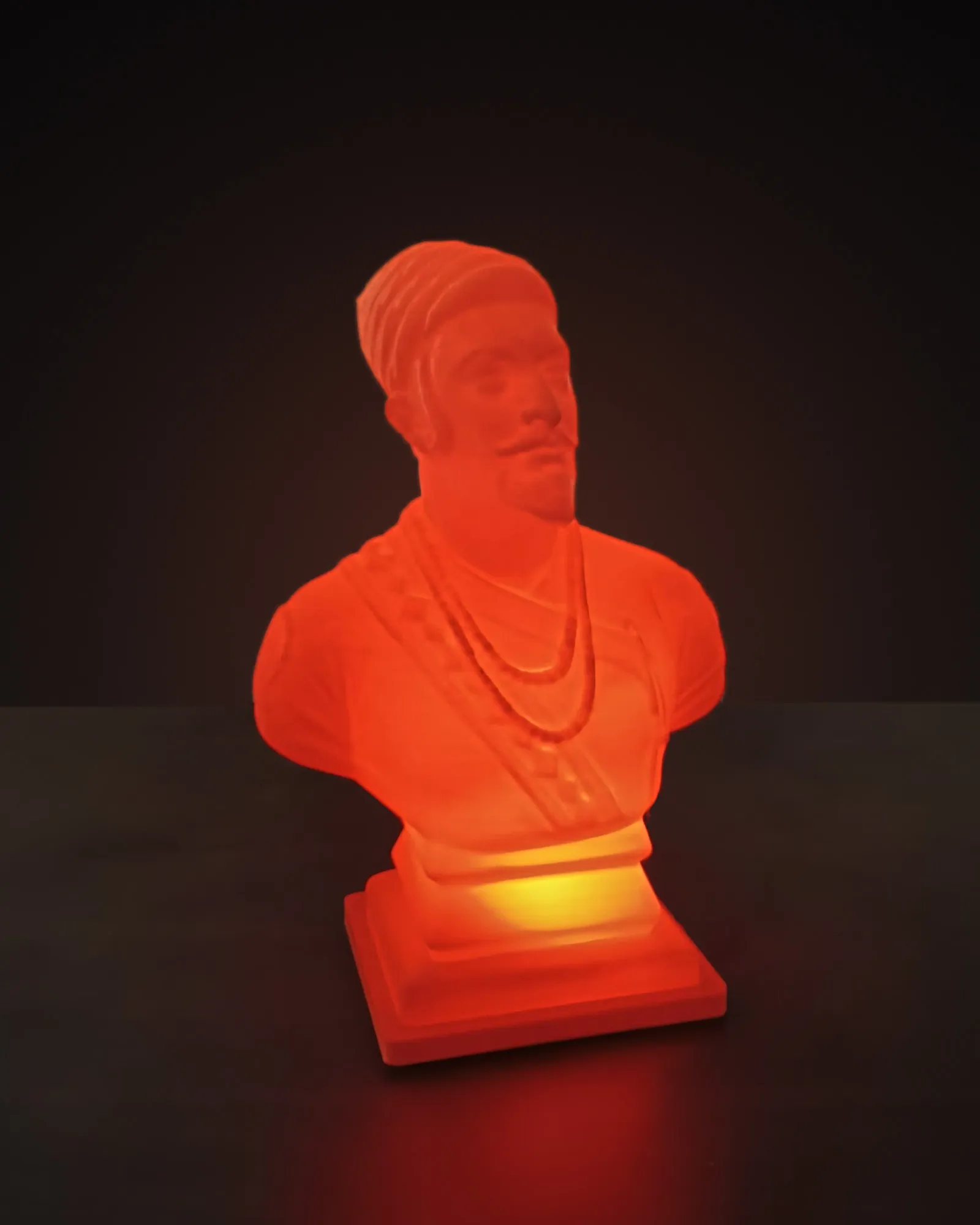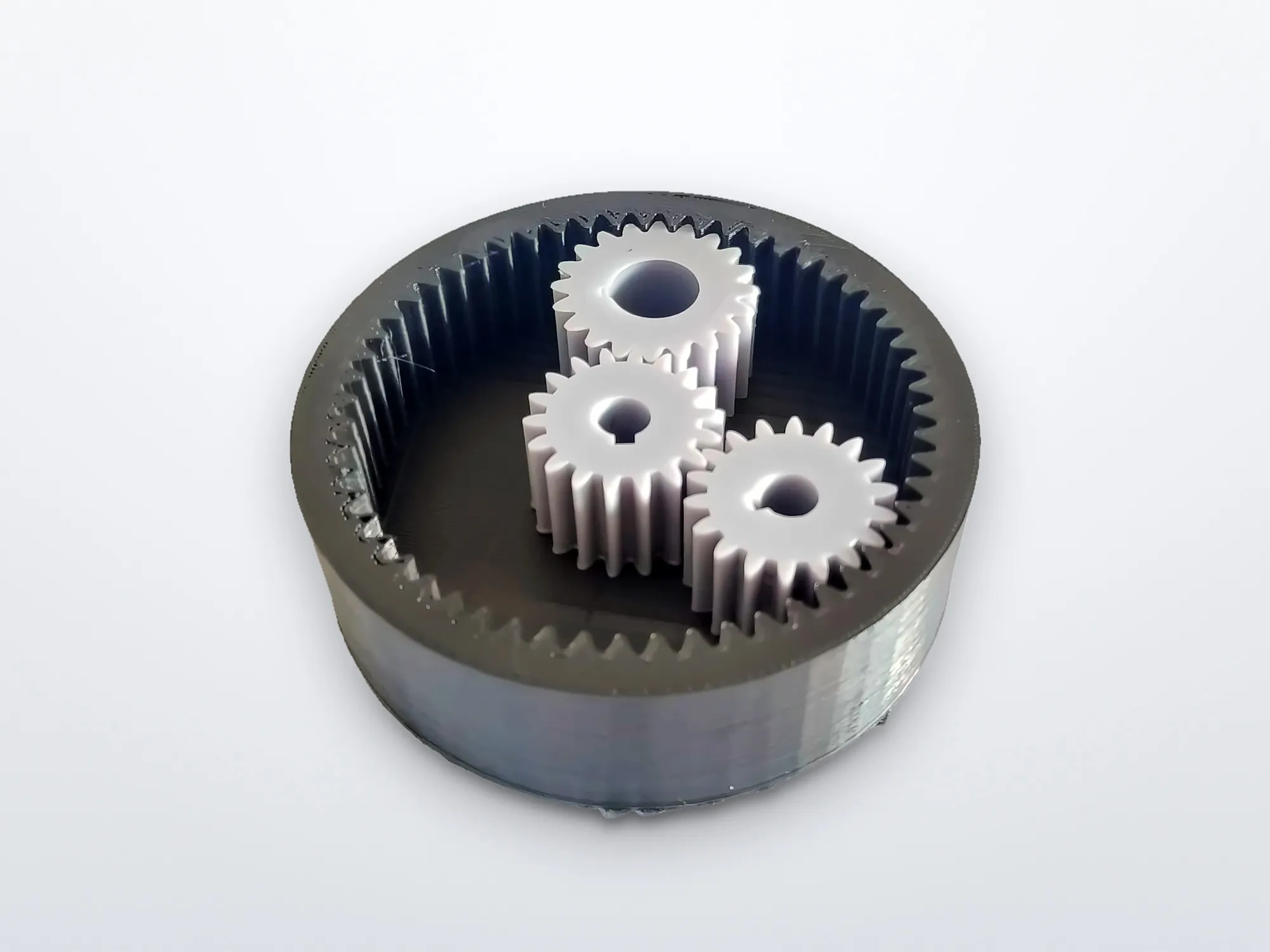
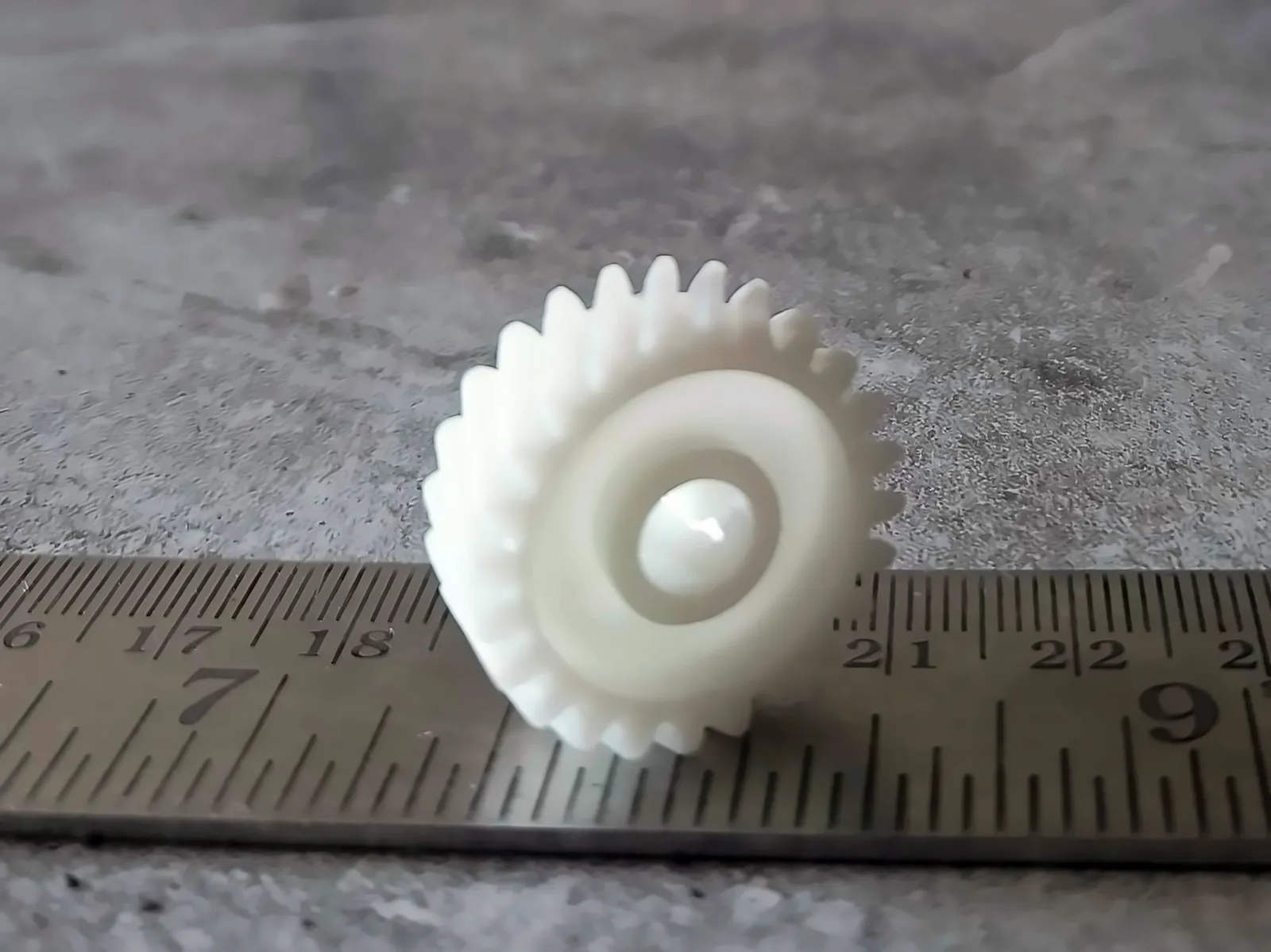
Some parts are simply too small or too detailed for FDM. A 10 mm gear with fine teeth, a connector housing with thin ribs, a nameplate with 2 mm text, a miniature for a scale model, a master for a jewellery-style casting: printed on an FDM machine, these come out with visible steps and soft edges. Engineers then either pay for machining or accept a part that does not really show what the design will be.
Resin printing solves this. AURO3D runs two resin printers in Savali, Sangli, printing at 0.05 mm layers with Standard, ABS-like (tough), Castable and Nylon-like resins. The parts come out with crisp edges, fine features and a smooth surface that needs far less finishing than FDM.
SLA, DLP and what we actually use
We want to be straightforward about this. Our resin machines are DLP printers. Most customers, and most of the internet, call all resin printing “SLA”, so that is the name on our menu.
The difference is in how the light reaches the resin:
- SLA (stereolithography) traces each layer with a laser spot, point by point.
- DLP (digital light processing) projects an image of the whole layer and cures it at once.
For you as a buyer, both produce the same kind of part: liquid photopolymer resin cured layer by layer into a solid with a smooth surface and fine detail. The practical things you should care about are layer height (ours is 0.05 mm), the resin type, the build size and the price. Because a DLP printer cures an entire layer in one exposure, the time to print a layer does not depend on how much of the plate is filled. That fact drives our pricing, explained below.
What resin printing is good for
- Small precise parts: gears, pulleys, clips, connector bodies, nozzles, small housings.
- Visual prototypes where surface and detail matter: consumer products, handheld devices, presentation pieces.
- Miniatures and scale-model details: figures, fittings, valves and small equipment for exhibition models.
- Casting patterns in castable resin for investment casting, and fine pattern details for sand casting.
- Masters for silicone moulds when you want to cast a short run in PU or wax.
Resin is not the right choice for large parts, parts that see sunlight or heat for long periods, or heavy-duty mechanical loads. For those, FDM in ABS, PETG or Nylon or injection moulding is better.
Resins we print
| Resin | Behaves like | Good for | Watch out for |
|---|---|---|---|
| Standard | Stiff, hard plastic | Visual models, fit checks, miniatures, masters | Brittle under impact; not for snap-fits |
| ABS-like (tough) | Tougher, less brittle plastic | Functional prototypes, enclosures, clips | Still softer under heat than moulded ABS |
| Castable | Wax-like burnout material | Investment-casting patterns | Not a functional part material |
| Nylon-like | Flexible, impact-resistant plastic | Snap-fits, living-hinge trials, clips | Less stiff; can creep under constant load |
More detail on each is in our resins material guide.
How resin pricing works
Resin pricing has three parts, all excluding GST:
- Resin volume used by the part (and its supports).
- Print height, because every 0.05 mm layer takes a fixed amount of machine time. A 60 mm tall part has 1,200 layers; a 20 mm tall part has 400.
- Handling of about ₹37.50 per part for preparation, washing, curing and support removal.
The shared build plate
Since each layer is cured in one exposure, a full build plate takes almost the same time as a plate with one part on it. When we print several parts together, the machine time is shared across all of them. That is why resin parts get noticeably cheaper per piece in batches, which FDM parts do not.
Indicative prices from our quote formula, Standard resin, excluding GST:
| Part (bounding box) | Qty 1 | Qty 10, each |
|---|---|---|
| Small gear 30 × 30 × 10 mm, solid | about ₹93 | about ₹78 |
| Bracket 50 × 30 × 20 mm, 3 mm wall | about ₹136 | about ₹107 |
| Figurine 40 × 40 × 60 mm, 2 mm wall | about ₹237 | about ₹148 |
| Enclosure 100 × 60 × 30 mm, 2 mm wall | about ₹260 | about ₹226 |
Two patterns stand out. The tall figurine drops the most in a batch, because its machine time (driven by its 60 mm height) is the largest cost and gets shared. The enclosure drops the least, because it is mostly resin volume, and a few of them already fill the plate.
A practical tip: if you have several small parts for the same project, send them together. Parts of a similar height printed on one plate cost less than the same parts ordered on separate days. These figures are indicative; the final quote depends on your file and orientation.
Build size and orientation
The build plate is 219 × 123 mm. Parts are usually printed at an angle on supports, which improves accuracy and surface quality but adds height, so the printed height is often more than the part’s own height.
We choose orientation to keep support marks off the faces you care about. If a particular face must be clean, such as a gear tooth flank, a sealing face or a visible logo, mark it in your enquiry.
Design tips for resin parts
- Minimum wall of about 1 mm for small features, thicker for anything that takes load.
- Hollow larger parts and add two drain holes, so trapped resin can escape and cost drops.
- Fine text and details of 0.3–0.5 mm print well; engraved text usually reads better than embossed at small sizes.
- Avoid long thin unsupported spans; they can bend during printing or curing.
- Allow small clearances for fits, typically about 0.1–0.2 mm per side, and confirm with a test print.
Finishing
Every resin part is washed in solvent, post-cured under UV light and cleaned of supports. Support contact points leave small nubs, which we sand flush on visible faces. For a painted, colour-matched or exhibition finish, our painting and finishing team primes and paints resin parts; resin takes paint better than FDM because there are no layer lines to fill.
Resin or FDM for small parts
| Factor | Resin (DLP) | FDM |
|---|---|---|
| Layer height | 0.05 mm | Thicker; visible layer lines |
| Fine features and small text | Crisp | Soft edges below a few mm |
| Surface off the printer | Smooth | Stepped |
| Batch pricing | Cheaper per part when the plate is shared | Nearly flat per part |
| Part size | Limited to the 219 × 123 mm plate | Larger parts possible |
| Toughness and heat | Depends on resin; generally lower | ABS, PETG and Nylon are tougher |
| Long-term outdoor use | Not recommended | PETG and ABS better suited |
For a quick decision: if the part fits in your palm and detail matters, choose resin. If it is larger, takes real load, or cost per part matters more than the look, choose FDM.
What to send us
- STL or STEP file, with units confirmed (mm).
- Resin type, or what the part has to do.
- Quantity, and whether other parts can be printed on the same plate.
- Faces that must be clean or dimensions that matter.
Quotes are valid for 7 days and GST at 18% is shown separately. We confirm the turnaround in your written quote. Call or WhatsApp +91 93568 71008, or use the form below. The quote guide explains what else helps.