“Should we 3D print this or get a mould made?” is the question behind many plastic-part enquiries. Buyers usually ask a printing shop, which recommends printing, or a moulder, which recommends a mould. Each answer suits the supplier more than the part. Get it wrong one way and you pay for a mould you never recover; get it wrong the other way and you overpay on every printed part for years.
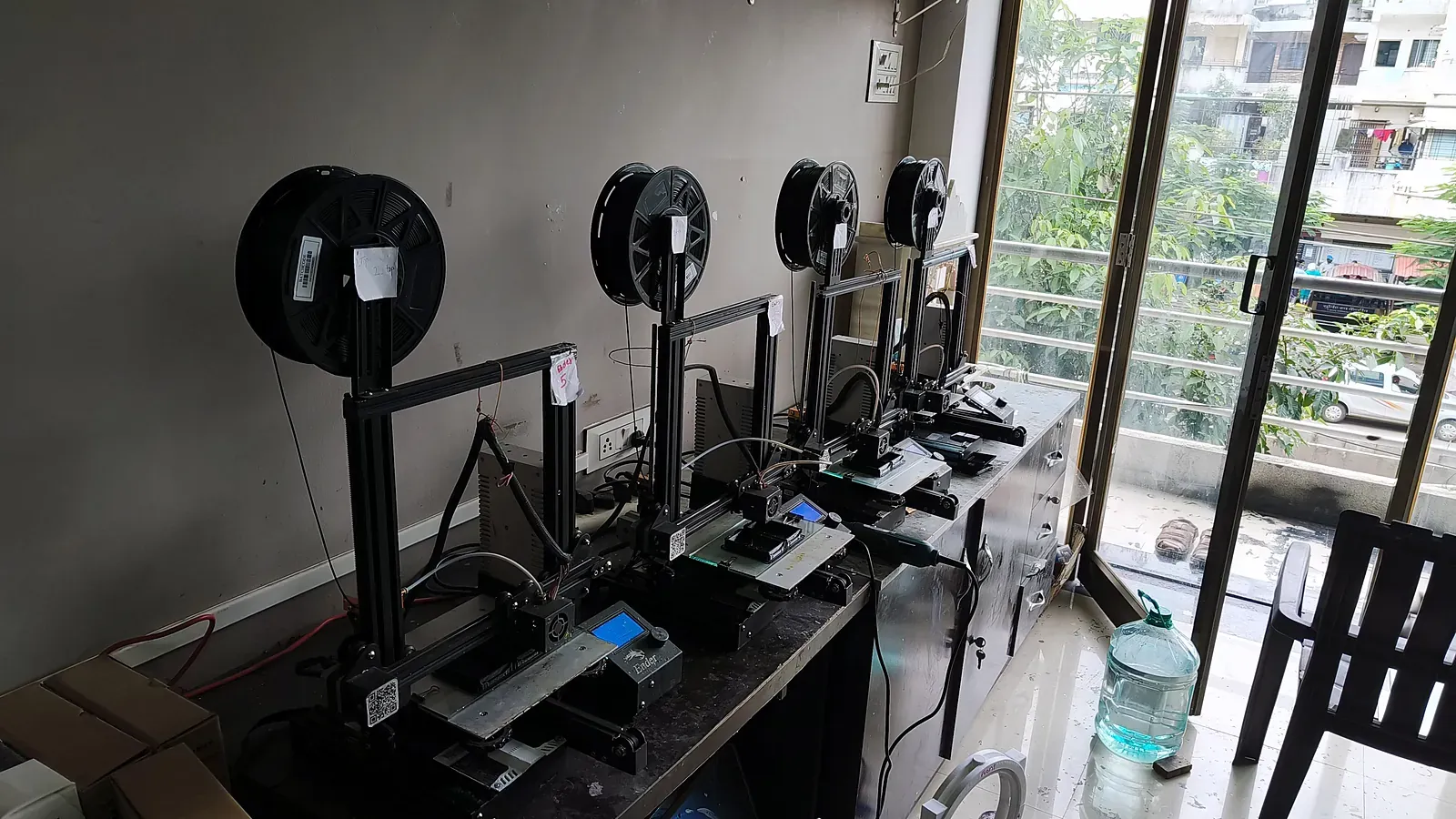
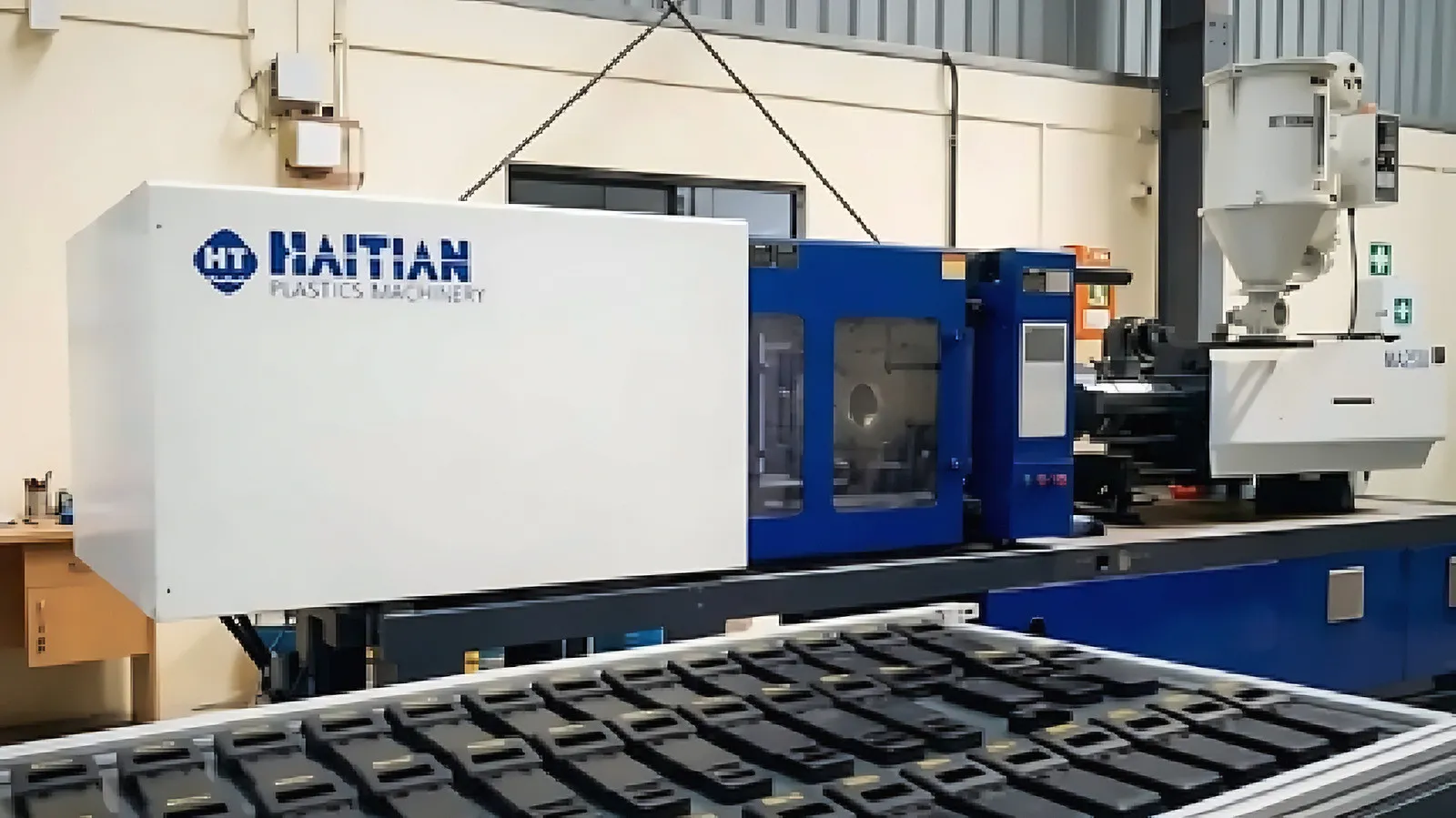
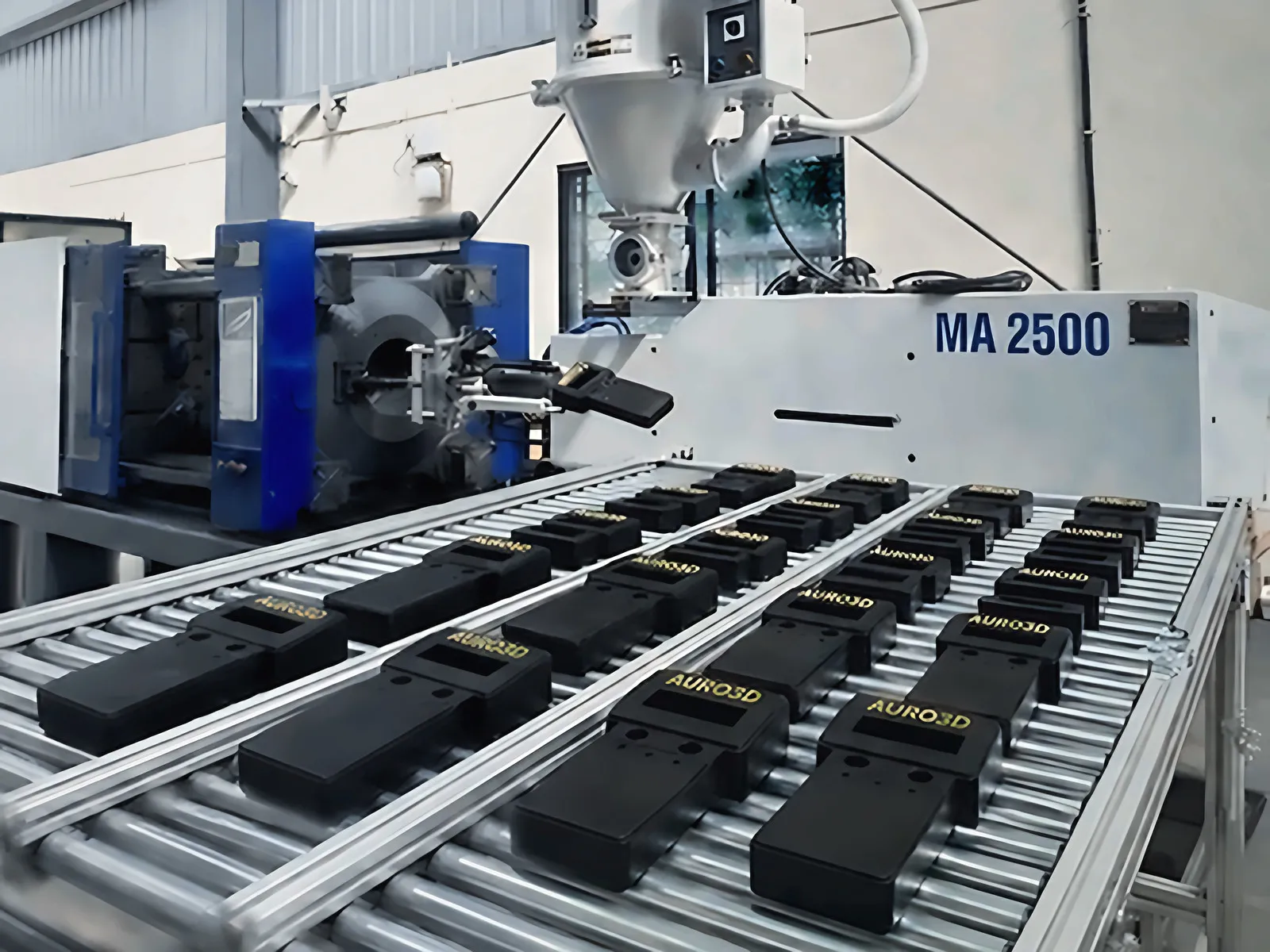
AURO3D runs both processes in one factory in Savali, Sangli: 12 FDM printers, 2 resin printers and a 250-tonne Haitian injection moulding press. We have no reason to push you toward one or the other, and we would rather give you the cheaper answer and keep you as a customer for the next part.
The short answer by quantity
These bands are a starting point. The real answer depends on part size, complexity, material and how settled the design is.
| Total quantity | Usually the better choice | Why |
|---|---|---|
| 1–10 | 3D printing | No tooling cost; parts in days; changes are free |
| 10–200 | 3D printing, often batch | A mould rarely pays back at this volume; 12 printers run in parallel |
| 200–1,000 | Depends on the part; calculate break-even | Small simple parts may justify a simple mould; large or complex parts usually do not |
| 1,000+ | Injection moulding, if the design is frozen | Tooling cost is spread thin; moulded parts cost a fraction per piece |
The important word in the last row is frozen. If your design will still change after the first thousand parts, every change means mould modification. In that case printing longer, or a simple bridge mould, can be the smarter choice.
How the two processes compare
| Factor | 3D printing (FDM / resin) | Injection moulding |
|---|---|---|
| Upfront cost | None | Mould cost, quoted per part |
| Cost per part | Higher; nearly flat with quantity | Much lower; falls as runs get longer |
| Time to first part | Days | Weeks, for mould design and build |
| Design changes | Free; edit the CAD and print | Costly mould rework |
| Part strength | Good; FDM weaker between layers | Solid, more uniform in all directions |
| Surface finish | FDM shows layers; resin is smooth | Consistent, set by mould finish |
| Geometry | Very flexible; undercuts and internal features are fine | Needs draft, even walls; undercuts add mould cost |
| Materials here | PLA, PETG, ABS, Nylon; four resins | PP, HDPE, ABS; others on request |
| Variants / personalisation | Free per part | Needs inserts or separate moulds |
| Best for | Prototypes, low volume, changing designs, custom parts | Proven designs with steady demand |
Why the cost curves cross
The heart of the decision is two very different cost structures.
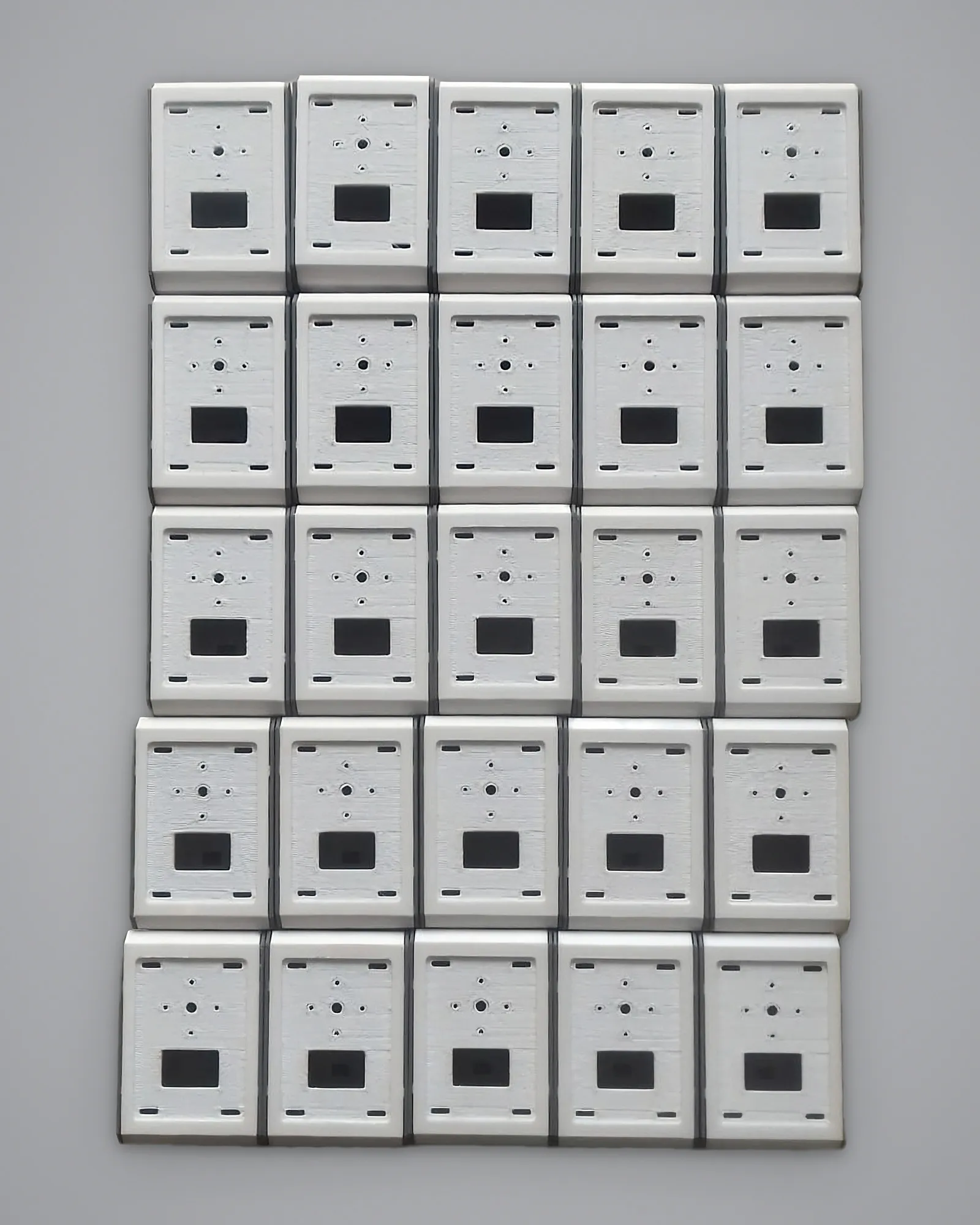
3D printing has almost no fixed cost and an almost flat cost per part. Using our indicative quote formula (excluding GST), a 100 × 60 × 30 mm enclosure with 2 mm walls costs about ₹170 in PLA or ₹214 in ABS, whether you order one or a hundred. Each part uses about 48 g of plastic and its own printer time. Our 12 printers make large batches faster, not much cheaper.
Injection moulding has a large fixed cost and a low cost per part. The mould is a one-time investment. After that, each cycle of the press produces one or more parts in seconds to a minute, using only the plastic in the part and runner. Moulded part prices depend on the part, material and quantity, and we quote them individually.
Plot total cost against quantity and you get two lines. Printing starts at zero and rises steeply. Moulding starts high, at the mould cost, and rises gently. Where they cross is the break-even quantity.
The break-even calculation
The formula is simple:
Break-even quantity = mould cost ÷ (printed price per part − moulded price per part)
An illustration, using made-up round numbers that are not our prices:
- Suppose a simple mould for the enclosure above were quoted at ₹60,000.
- The printed ABS part costs about ₹214.
- Suppose the moulded ABS part costs ₹24.
- The saving per part is ₹214 − ₹24 = ₹190.
- Break-even = ₹60,000 ÷ ₹190 ≈ 316 parts.
Below about 316 parts in total, printing is cheaper. Above it, every moulded part saves you about ₹190. At 2,000 parts, that is roughly ₹3.2 lakh saved after paying for the mould.
Change the inputs and the answer moves a lot. A larger part with more plastic makes printing more expensive and pulls the break-even down. A complex mould with sliders pushes it up. That is why we calculate it for each part rather than quoting a rule of thumb. Our break-even guide works through several examples and the hidden costs on both sides.
Things the formula leaves out
- Lifetime quantity, not order quantity. Count all the parts you expect to buy over the life of the design, not just the first order.
- Design risk. If there is a real chance the design changes, add the cost of mould modification to the moulding side.
- Cash flow. A mould is paid upfront; printed parts are paid as you buy them. For a start-up, this can matter more than the total.
- Time. Printing gets parts to the market weeks earlier while the mould is being made.
- Quality needs. Some parts need moulding for strength or finish regardless of cost; some need printing for geometry a mould cannot make.
The best plan is often both
For new products, the strongest plan is usually sequential:
- Prototype in FDM or resin until the design works.
- Batch-print the first lots for pilots and early customers on our low-volume production service.
- Freeze the design and run a DFM review for moulding.
- Build the mould while printers keep supplying parts.
- Switch to moulded production after you approve first-off samples.
Because both happen in one factory, the same engineer and the same CAD carry through every step. Our DFM checklist lists what to check before paying for a mould.
Where resin printing fits in
Resin printing sits between FDM and moulding for small parts. It gives a smooth surface and fine detail at 0.05 mm layers, and unlike FDM it gets cheaper per part in batches, because several parts share the build plate and each layer is cured in one exposure.
From our indicative quote formula (Standard resin, excluding GST): a 50 × 30 × 20 mm bracket costs about ₹136 alone, or about ₹107 each in a batch of 10. A 40 × 40 × 60 mm figurine drops from about ₹237 to about ₹148 each.
That makes resin a strong choice for small detailed parts up to a few hundred pieces, where FDM would need heavy finishing and a mould is not yet justified. It is less suitable for large parts, which are limited by the 219 × 123 mm build plate, and for parts that see long sun exposure or heat. See resin printing for details.
What to send us for a recommendation
- CAD file (STEP preferred) or a drawing.
- Material or the working conditions.
- Quantity now and expected lifetime quantity.
- How settled the design is, and when you need parts.
We will price both routes where sensible and show you the break-even. Call or WhatsApp +91 93568 71008, or use the form below and choose “Not sure — advise me”.