
When a part needs to be made in thousands, cost per piece starts to dominate every decision. Polypropylene is one of the cheapest engineering-useful plastics by volume, it is the lightest of the common ones, and it does things others cannot, such as flexing at a thin hinge for the life of the product.
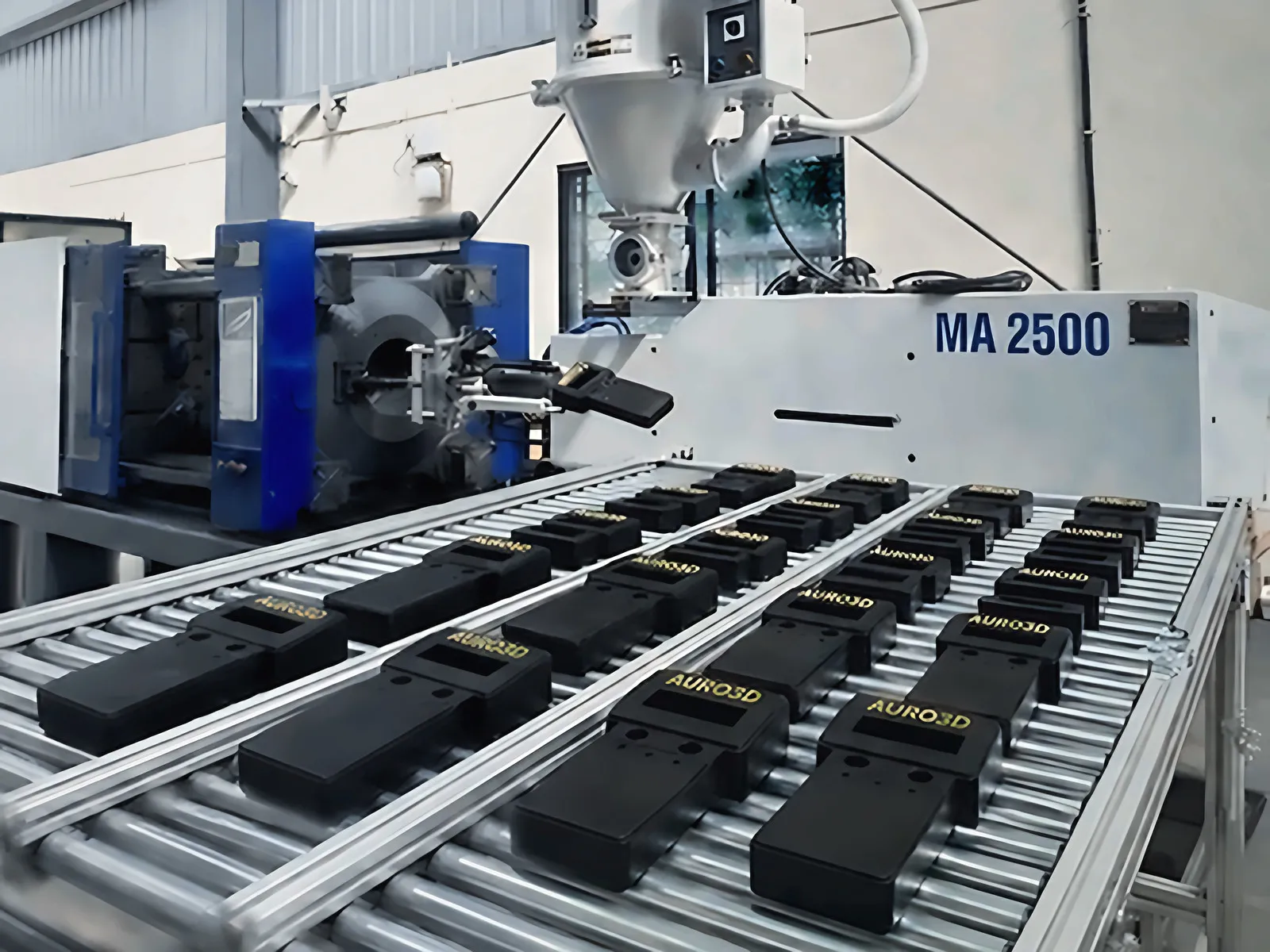
We mould PP on our 250-tonne Haitian MA 2500 servo-hydraulic press in Savali, Sangli. Before any mould is built, we check your design for moulding and prove the shape with a 3D-printed sample, so the money goes into a mould that works first time.
Why choose polypropylene
- Chemical resistance. PP resists most acids, alkalis, detergents, many oils and water. It is a common choice for containers, battery parts, lab and agricultural components.
- Living hinges. PP survives repeated bending at a thin section, so a box and its lid, or a cap and its spout, can be moulded as one part.
- Light weight. At about 0.9 g/cm³ it is lighter than water, and lighter than ABS or HDPE, so the same part uses less material by weight.
- Low cost. Raw material cost per kg is generally among the lowest of the engineering-useful plastics.
- Toughness. Copolymer grades in particular take knocks well.
The limitations
- High shrinkage. Typically about 1–2.5%, and not always equal in every direction. Tight tolerances and large flat faces need careful design and gating.
- Hard to paint, print or glue. Low surface energy means surface treatment is needed. Moulded-in colour is the usual answer.
- Lower stiffness than ABS. Long, thin PP parts flex; ribs help.
- Cold impact. Homopolymer PP becomes brittle in cold conditions; copolymer grades are better.
- UV. Unstabilised PP degrades in strong sunlight; outdoor parts need a UV-stabilised grade or black colour.
When to choose PP, and when not to
Choose PP when:
- the part has a hinge, a snap lid or a flip-top;
- it touches chemicals, fertilisers, detergents or water;
- the quantity is high and price per part is critical;
- light weight matters.
Do not choose PP when the part must be painted or glued, must look glossy and premium, needs tight tolerances on a large part, or must be very stiff. For those, ABS is usually better.
PP compared with HDPE and ABS
| PP | HDPE | ABS | |
|---|---|---|---|
| Density (typical) | ~0.90–0.91 g/cm³ | ~0.94–0.97 g/cm³ | ~1.03–1.06 g/cm³ |
| Typical moulding shrinkage | ~1–2.5% | ~1.5–3% | ~0.4–0.7% |
| Stiffness | Medium | Lower | Higher |
| Living hinge | Yes | Limited | No |
| Chemical resistance | Very good | Very good | Moderate |
| Paint / glue | Difficult | Difficult | Easy |
Values are typical ranges from general material data; actual figures depend on the grade.
Designing a PP part
- Keep walls even, roughly 1–3 mm for small parts. PP is forgiving of thin walls but sinks in thick sections.
- Draft of 1–2° on faces parallel to the mould opening; more on textured faces.
- Living hinges are typically a few tenths of a millimetre thick with generous radii; the gate must let material flow across the hinge, not along it.
- Allow for shrinkage in tolerances; avoid specifying tight tolerances on non-critical dimensions.
- Use snap-fits. PP’s flexibility suits them well and saves screws.
Our DFM checklist covers these rules in more detail. We apply them in the free review on every moulding enquiry.
Homopolymer or copolymer?
PP comes in two broad families. Homopolymer is stiffer and handles slightly more heat; copolymer is tougher, especially when cold, and is often chosen for parts that may be dropped. We suggest the family from your description of the part’s use, and confirm the exact grade at quote stage.
Cost and quantities
The economics of PP depend on the mould cost and the per-part price, which we quote individually for each part. Below a few hundred parts, 3D printing is usually cheaper because there is no tooling. We calculate the crossover for every moulding enquiry; the break-even guide shows how.
Next step
Send a STEP file, the expected annual quantity, colour, and what the part touches. We will check it for moulding, suggest the PP grade type, and quote the mould and parts separately. Call or WhatsApp +91 93568 71008.