
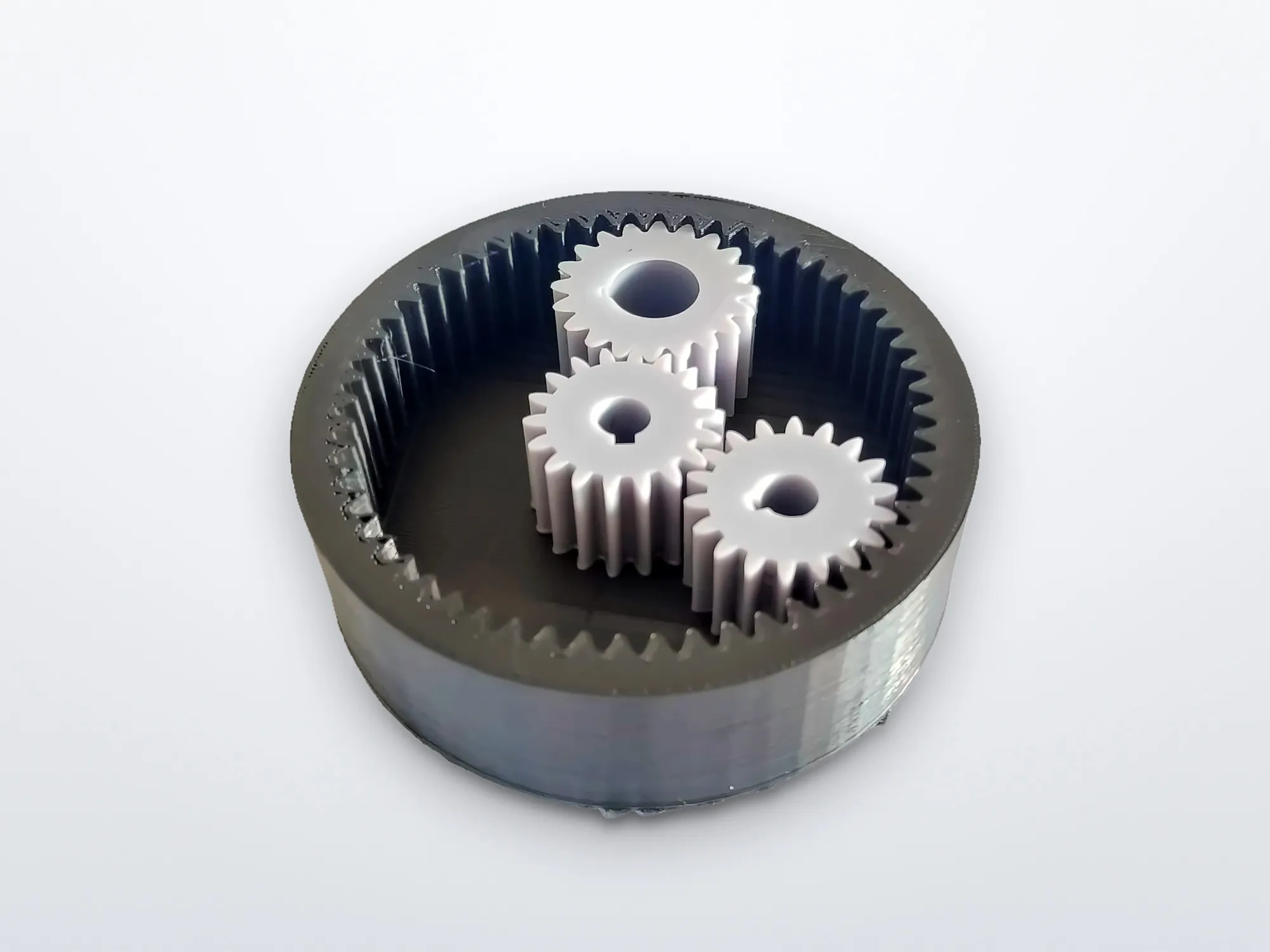
Machine builders and maintenance teams often need one plastic part that does not exist any more: a worn gear from an old machine, a bush that the original supplier stopped making, a guide roller that wears out every few months. Machining it from nylon or acetal rod is possible, but slow and costly for a complex shape.
Printed nylon fills that gap. On our FDM printers in Sangli we can produce a working gear, bush or clip from a CAD file or from your worn sample, which we can reverse-engineer first. It is the most expensive of our FDM materials, and for wear parts it is usually the only one worth using.
What nylon does better than other FDM plastics
Nylon (polyamide) is the same family of plastic used in machined bushes, cable ties and moulded gears. When printed, it keeps most of the qualities that make it useful on machines:
- Toughness. It bends and absorbs shock rather than cracking. Dropped or overloaded nylon parts usually deform before they break.
- Low friction and wear. It slides against steel and against itself with less wear than PLA, PETG or ABS, often without lubrication.
- Fatigue resistance. Clips, latches and flexures survive many more cycles.
- Heat. It handles more heat than PLA and PETG, though the exact limit depends on the grade and how much moisture it has absorbed.
The trade-offs
- Moisture. Nylon absorbs water from the air. This makes it tougher but softer, and it grows slightly in size. For tight fits in humid conditions, allow clearance and test first.
- Lower stiffness. It is less rigid than PLA or ABS. A large flat nylon panel will flex; add ribs or choose another material.
- Cost. At about ₹7.06 per gram plus handling, it is more than double the PLA rate.
- Appearance. Surfaces are matte and nylon is hard to paint, so it is a poor choice for cosmetic covers.
When to choose nylon, and when not to
Choose nylon when:
- the part is a gear, bush, roller, cam, wear pad or slide;
- it is a clip, latch or hinge that will flex many times;
- it is a replacement part on a machine, where toughness matters more than looks;
- the part will take impact or vibration.
Do not choose nylon when the part is mainly cosmetic, must stay dimensionally exact in a humid place, is a large rigid panel, or when PETG would do the job at less than half the price.
Nylon compared with PETG and ABS
| Nylon | PETG | ABS | |
|---|---|---|---|
| Wear and friction | Very good | Fair | Fair |
| Toughness / fatigue | Very good | Good | Good |
| Stiffness | Lower | Medium | Medium-high |
| Moisture sensitivity | Absorbs water | Low | Low |
| Painting | Poor | Fair | Very good |
| Indicative FDM price | ≈ ₹7.06/g + ₹18.75 | ≈ ₹3.13/g + ₹18.75 | ≈ ₹4.05/g + ₹18.75 |
What nylon parts cost
For a rough feel, using our formula and excluding GST: a solid 30 × 30 × 10 mm gear of about 11 g comes to about ₹95 in nylon, compared with about ₹53 in PLA. A 50 × 30 × 20 mm bracket with 3 mm walls (about 18 g) is roughly ₹148, against ₹76 in PLA. These are indicative; the final quote depends on your actual file. For a single replacement gear that keeps a machine running, that difference rarely matters.
Design tips for printed nylon parts
- Gears: use a module and face width that keep tooth stress low, and avoid very small modules on printed gears. Allow a little extra backlash.
- Bushes and holes: design holes slightly oversize and ream or drill to final size if the fit is critical.
- Walls: 2–4 mm is a sensible range for most functional parts.
- Clips: add generous fillets at the root of any flexing feature.
Getting a nylon part made
Send the CAD file, or the worn part itself with the mating part if possible. Tell us the load, speed and environment (oil, water, temperature). We will confirm whether nylon is the right choice before you pay. Call or WhatsApp +91 93568 71008.