
Most first prototypes do not need an engineering plastic. They need to arrive quickly, be accurate enough to check the fit, and cost little enough that a second and third revision do not hurt. PLA does exactly that.
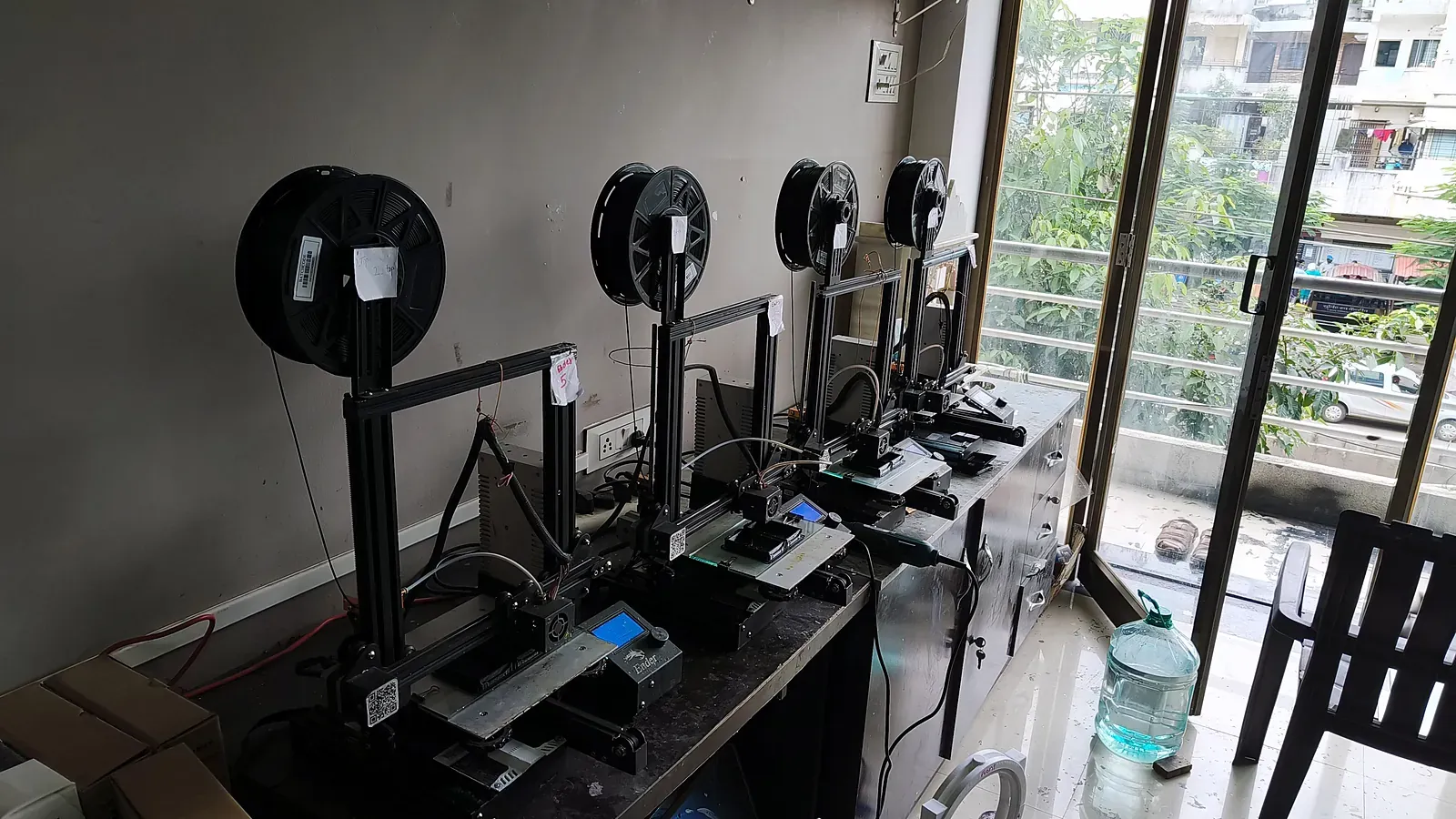
At AURO3D, PLA runs on most of our 12 FDM printers in Savali, Sangli. It prints with very little warping, so parts come off the bed close to the CAD size and we can run several jobs in parallel. It is also our lowest-cost FDM material, priced the same as PETG and below ABS and Nylon.
What PLA is good at
PLA (polylactic acid) is a stiff thermoplastic that melts at a relatively low temperature. That low melting point is both its strength and its weakness.
- Accuracy. It shrinks very little as it cools, so flat faces stay flat and holes stay round. That makes it a good choice for fit checks against a PCB, a bought-out component or a mating part.
- Fine detail. Sharp edges, small text and thin features print cleanly.
- Easy finishing. It sands, primes and paints well. Most of the architectural and exhibition models we make start as PLA.
- Low cost. At about ₹3.13 per gram plus handling, it is the cheapest way to get a real part in your hand.
Where PLA fails
The same low melting point means PLA softens from roughly 55–60 °C. In practice that rules out:
- parts inside a vehicle, a control panel with a hot transformer, or near a motor;
- outdoor parts in direct sun, which can reach those temperatures on a summer afternoon in Maharashtra;
- clips, snap-fits and hinges that flex many times — PLA tends to crack rather than bend;
- parts that will be dropped or hit.
PLA also slowly creeps under constant load, so a PLA bracket holding weight for months may sag even at room temperature.
When to choose PLA, and when not to
Choose PLA when:
- you are checking shape, size and fit before committing to a final material or a mould;
- the part is a model, display piece, mock-up or teaching aid;
- you need a casting pattern for a sand foundry;
- the jig or fixture stays at room temperature and takes only light load.
Do not choose PLA when the part gets warm, lives outdoors, takes impact, or must snap together repeatedly. Move to PETG for a cheap step up in toughness, ABS for heat and a better painted finish, or Nylon for wear and repeated flexing.
PLA compared with PETG and ABS
| PLA | PETG | ABS | |
|---|---|---|---|
| Softens from (typical) | ~55–60 °C | ~75–80 °C | ~95–105 °C |
| Impact toughness | Low | Good | Good |
| Dimensional accuracy when printing | Best | Good | Needs care (warps) |
| Outdoor / UV | Poor | Fair | Poor unless painted |
| Painting | Very good | Fair | Very good |
| Indicative FDM price | ≈ ₹3.13/g + ₹18.75 | ≈ ₹3.13/g + ₹18.75 | ≈ ₹4.05/g + ₹18.75 |
Temperatures are typical published ranges for the base polymers and vary by brand and grade. Our PLA vs PETG vs ABS guide goes through the trade-offs in detail.
What PLA parts cost
Our quote formula prices FDM PLA at about ₹3.13 per gram plus ₹18.75 handling per part, before 18% GST. Some indicative examples:
| Part | Approx. weight | Indicative PLA price (excl. GST) |
|---|---|---|
| Small gear 30 × 30 × 10 mm, solid | ~11 g | ₹53 |
| Bracket 50 × 30 × 20 mm, 3 mm wall | ~18 g | ₹76 |
| Enclosure 100 × 60 × 30 mm, 2 mm wall | ~48 g | ₹170 |
| IoT box 163 × 163 × 62 mm, 2.5 mm wall | ~269 g | ₹862 |
Ten of the enclosures come to ₹1,699 plus ₹306 GST, so ₹2,005 in total. FDM has almost no quantity discount, so the price per part stays nearly flat. If you need thousands of the same part, look at injection moulding instead. Final prices always depend on your actual file.
Design tips for PLA parts
- Walls of 1.6–3 mm suit most small parts. Thinner walls print but feel flimsy.
- Leave clearance of roughly 0.2–0.4 mm between mating parts that must slide or press together. Exact fit depends on geometry, so print a test pair first if it matters.
- Orient for strength. FDM parts are weakest between layers. Tell us which direction the load comes from and we will orient the part to suit.
- Avoid thin, tall pins that will be bent; they snap along a layer line.
Getting a PLA part made
Send a STEP or STL file, the quantity and the colour you need. If you are not sure PLA is right, tell us what the part does and where it will be used, and we will suggest the material. See how to get a quote fast for the full list of what helps, or call or WhatsApp +91 93568 71008.