
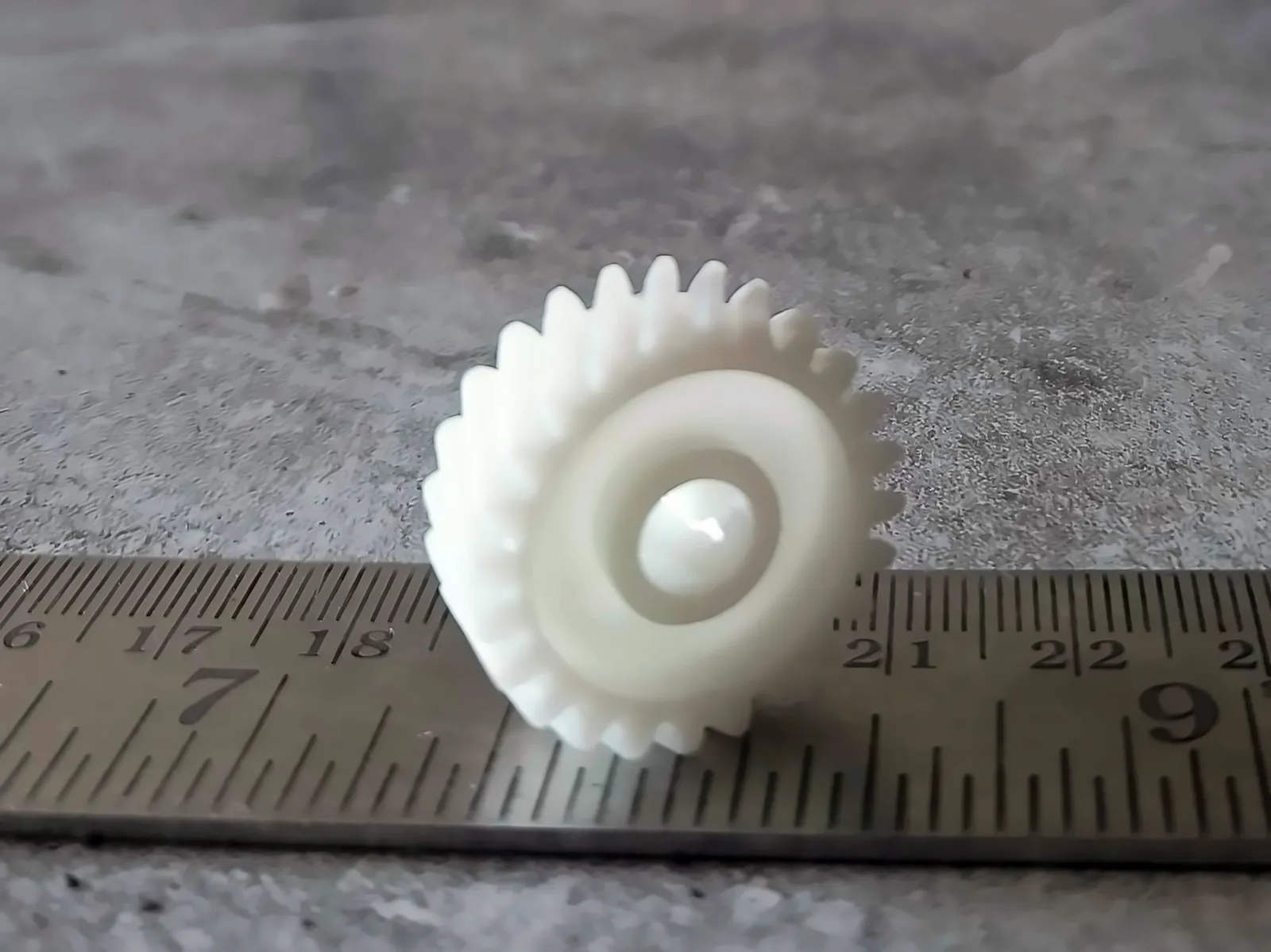
FDM is the right process for most functional parts, but it has limits. Layer lines show on curved surfaces, small text blurs, and tiny features such as gear teeth under a few millimetres, fine threads or facial details on a figurine are hard to hold.
Resin printing solves that. Our two DLP resin printers in Sangli build parts at 0.05 mm layers on a 219 × 123 mm plate, producing smooth surfaces and sharp detail straight off the machine. The trade-off is that resin parts are smaller, more expensive per gram, and generally less tough than FDM thermoplastics. Choosing the right resin closes part of that gap.
The four resins we offer
| Resin | What it is for | Strengths | Limitations |
|---|---|---|---|
| Standard | Visual prototypes, figurines, miniatures, display parts, small cosmetic samples | Finest detail, smooth surface, easy to paint | Brittle; snaps if bent or dropped |
| ABS-like (tough) | Functional prototypes, snap-fits, small housings, parts that are handled | More impact-resistant and less brittle than standard | Slightly less crisp detail; still not real ABS |
| Castable | Investment-casting patterns for jewellery and small metal parts | Burns out with low residue when the burnout cycle suits it | Soft and fragile; not for functional use |
| Nylon-like | Small detailed parts that need some flex and toughness | Tougher, more forgiving than standard resin | Lower stiffness; heat resistance still modest |
How resin printing differs from FDM
- Detail. The 0.05 mm layer and the projected-image curing capture fine features that FDM nozzles cannot.
- Surface. Curved and sloping surfaces come out smooth, so painted parts need little sanding.
- Isotropy. Resin parts are more uniform in strength across layers than FDM parts.
- Material behaviour. Photopolymers are thermosets, not thermoplastics. They generally handle less heat and impact than ABS or Nylon and can degrade with long UV exposure.
- Size. The 219 × 123 mm plate suits small and medium parts; large parts belong on FDM.
When to choose resin, and when not to
Choose resin when:
- the part is small and detail matters: figurines, miniatures, small gears, connectors, knobs, jewellery;
- you need a smooth surface for a cosmetic prototype or a painted model;
- you need a pattern for investment casting;
- you want ten or more small identical parts at once, which share the build plate.
Do not choose resin when the part is large, takes heavy impact, works outdoors in strong sun, runs warm, or when the detail is not needed. In those cases PETG, ABS or Nylon on FDM will be cheaper and tougher.
Resin compared with FDM PLA
| Standard resin | FDM PLA | |
|---|---|---|
| Layer height | 0.05 mm | Coarser; layer lines visible |
| Fine detail and text | Excellent | Fair |
| Toughness | Brittle | Brittle-ish, but larger parts hold up better |
| Max part size | Plate 219 × 123 mm | Larger parts possible |
| Pricing basis | Volume + print height + ₹37.50/part | ≈ ₹3.13/g + ₹18.75/part |
How resin parts are priced
Resin pricing depends on two things: the volume of resin in the part, and the height of the print, because machine time is set by the number of layers, not by how many parts are on the plate. That is why batches of small parts get cheaper per piece. Indicative examples from our formula (excl. GST):
| Part | Qty 1 | Qty 10, each |
|---|---|---|
| Small gear 30 × 30 × 10 mm | ₹93 | ₹78 |
| Bracket 50 × 30 × 20 mm | ₹136 | ₹107 |
| Figurine 40 × 40 × 60 mm | ₹237 | ₹148 |
| Enclosure 100 × 60 × 30 mm | ₹260 | ₹226 |
| IoT box 163 × 163 × 62 mm | ₹1,108 | ₹1,108 |
The large IoT box gets no batch saving because it occupies the plate on its own. The final price depends on your actual file.
Getting resin parts made
Send an STL or STEP file, the resin you have in mind (or what the part must do), the quantity, and whether you need painting. For castable patterns, tell us your foundry’s burnout process. Call or WhatsApp +91 93568 71008.