
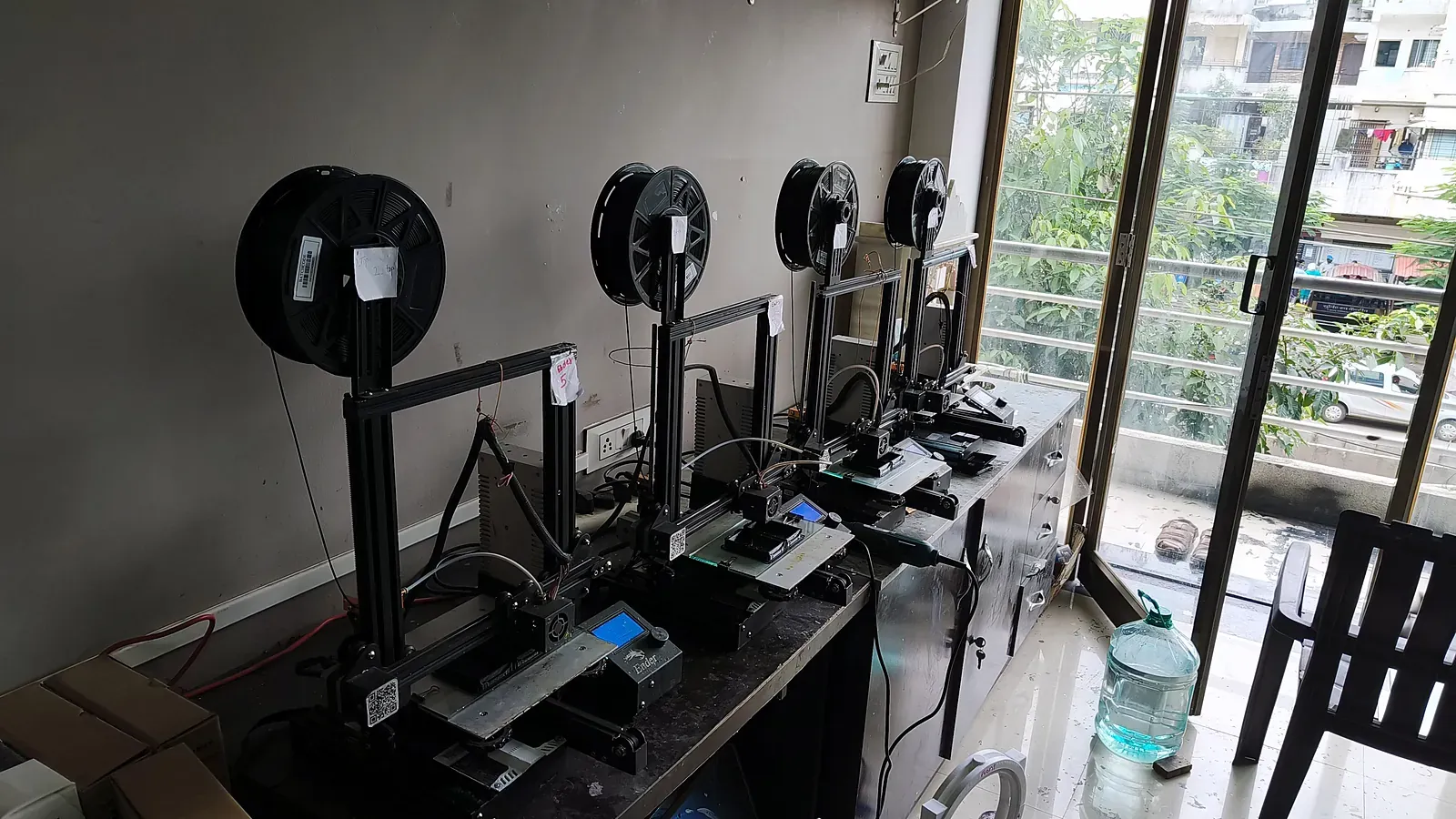
Ask five 3D printing services in India for a price and you will get five numbers that are hard to compare. One quotes “₹2 per gram”, another quotes per hour, a third sends a lump sum with no breakdown, and GST may or may not be included. A buyer who picks the lowest number often finds out later that the part was printed with thin walls, in a different material, or without support removal.
This guide shows how a 3D printing price is actually built, using the same formula AURO3D uses to quote at our print room in Savali, Sangli. Every AURO3D price below comes from that formula, rounded to the rupee. All prices are indicative and exclude GST unless stated; the final quote always depends on your actual file.
What actually drives the price of a 3D print
Weight is the easiest number to talk about, but it is only one of six cost drivers. A fair quote covers all of them.
| Driver | What it is | How it shows up in our price |
|---|---|---|
| Material | Filament or resin consumed, including supports | Part of the per-gram rate |
| Machine time | Printer depreciation, electricity, floor space | Part of the per-gram rate (FDM) or priced by print height (resin) |
| Handling and labour | File check, slicing, plate setup, removing the part | Fixed charge per part: ₹18.75 FDM, ₹37.50 resin |
| Supports | Removing supports, and for resin, washing and UV curing | Included in the resin handling charge |
| Finishing | Sanding, priming, painting | Quoted separately |
| Margin | Failed prints, design support, overheads, profit | Built into the rates above |
Two drivers matter far more than people expect. Machine time is roughly half of the FDM per-gram rate, and it is why a slow material costs more even when the raw filament is cheap. Handling is a fixed amount per part, so on small parts it can be a third of the price.
AURO3D’s per-gram rates for FDM
For FDM, our formula reduces to a simple rule: price per part ≈ weight in grams × rate per gram + ₹18.75 handling.
| FDM material | Rate per gram | Handling per part | Why the rate differs |
|---|---|---|---|
| PLA | ₹3.13 | ₹18.75 | Fast, easy to print |
| PETG | ₹3.13 | ₹18.75 | Same material cost and print speed as PLA in our formula |
| ABS | ₹4.05 | ₹18.75 | Prints slower; prone to warping |
| Nylon | ₹7.06 | ₹18.75 | Costlier filament and the slowest print speed |
The ABS rate shows why “price per gram” is really “price per gram of machine time”. ABS filament costs only slightly more than PLA, but we budget about 10 grams per printer-hour for ABS against about 15 for PLA. That extra machine time is most of the 30% difference.
A quick check with the 100 × 60 × 30 mm enclosure used throughout this guide: with 2 mm walls it weighs about 48 g. In PLA that is 48.3 g × ₹3.13 = ₹151, plus ₹18.75 handling, so about ₹170 per part. The same part in ABS comes to ₹214, and in Nylon ₹360.
Weight is calculated at 1.2 g/cm³ for estimates. Once we have your file, we use the sliced weight of the real part.
Why resin is priced by height, not by weight
Our two resin printers use DLP technology (most customers call it SLA). They cure a full layer of the build plate in one exposure, 0.05 mm at a time. A layer takes the same time whether it holds one small part or the whole 219 × 123 mm plate is full. So resin print time depends on how tall the job is, not how much material it uses.
Our quote tool budgets about 12 seconds per layer, which is roughly 4 minutes per millimetre of height. A 30 mm tall part ties up the printer for about 2 hours; a 60 mm tall part for about 4 hours. That machine time is shared by everything on the plate. On top of this come the resin itself (about ₹3.60 per gram for Standard resin, ₹4.80 for ABS-like) and ₹37.50 handling per part for washing, UV curing and support removal.
One part vs ten parts
Take a 40 × 40 × 60 mm figurine with 2 mm walls (about 28 g) in Standard resin. Fifteen of them fit on one plate.
| Quantity | Price per part | Order value |
|---|---|---|
| 1 | ₹237 | ₹237 |
| 2 | ₹188 | ₹375 |
| 5 | ₹158 | ₹791 |
| 10 | ₹148 | ₹1,485 |
| 15 (one full plate) | ₹145 | ₹2,178 |
| 20 (needs a second plate) | ₹148 | ₹2,970 |
Ordering ten instead of one cuts the price per part by about 38%. Past a full plate the saving stops, because the 16th part starts a new 4-hour print. Compare that with FDM, where the same figurine costs ₹107 in PLA whether you order one or ten.
Orientation changes the price too
The same 100 × 60 × 30 mm enclosure in Standard resin:
| How it sits on the plate | Height | 1 part | 10 parts, each |
|---|---|---|---|
| Flat | 30 mm | ₹260 | ₹226 |
| On its long side | 60 mm | ₹309 | ₹231 |
| Standing on end | 100 mm | ₹375 | ₹228 |
For one part, standing it upright costs 44% more than laying it flat. In real jobs we also orient for surface quality and support marks, so the cheapest orientation is not always the right one. We tell you when there is a trade-off.
Five worked examples
These come straight from our quote formula. Dimensions are the bounding box and the wall thickness modelled.
| Part (bounding box, wall) | Approx. weight | FDM PLA | FDM ABS | Resin Standard, 1 pc / each of 10 |
|---|---|---|---|---|
| Enclosure 100 × 60 × 30 mm, 2 mm wall | 48 g | ₹170 | ₹214 | ₹260 / ₹226 |
| Bracket 50 × 30 × 20 mm, 3 mm wall | 18 g | ₹76 | ₹93 | ₹136 / ₹106 |
| Small gear 30 × 30 × 10 mm, solid | 11 g | ₹53 | ₹62 | ₹93 / ₹78 |
| Figurine 40 × 40 × 60 mm, 2 mm wall | 28 g | ₹107 | ₹133 | ₹237 / ₹148 |
| IoT box 163 × 163 × 62 mm, 2.5 mm wall | 269 g | ₹862 | ₹1,109 | ₹1,108 / ₹1,108 |
A few patterns stand out:
- Small parts are dominated by handling. On the 11 g gear, ₹18.75 of the ₹53 PLA price is handling.
- Resin beats FDM ABS only on large, flat parts. The IoT box is so wide that only one fits per plate, so resin gains nothing from quantity, and at 62 mm tall its print time is moderate. The ₹1,108 resin price ends up almost equal to ABS.
- Resin suits small, detailed parts in batches, where many share a plate. Choose it for detail and surface finish, not to save money on large parts.
GST on 3D printing: a full example
We charge 18% GST, shown separately. Whether it appears as CGST + SGST or as IGST depends on where you are, not on what you order. For a GST-registered business the tax is normally available as input tax credit; confirm with your accountant.
Example: 10 PLA enclosures, 100 × 60 × 30 mm, 2 mm wall.
| Line | Buyer in Maharashtra (e.g. Kolhapur, Pune) | Buyer in another state (e.g. Belagavi, Karnataka) |
|---|---|---|
| 10 × ₹170 (exact: ₹169.95) | ₹1,699 | ₹1,699 |
| CGST 9% | ₹153 | — |
| SGST 9% | ₹153 | — |
| IGST 18% | — | ₹306 |
| Total payable | ₹2,005 | ₹2,005 |
The same ten enclosures in Standard resin come to ₹2,260 + ₹407 GST = ₹2,666. Our payment terms are 50% advance and 50% before dispatch, so on the PLA order you would pay about ₹1,003 to start and the balance before the parts leave the factory.
When you compare quotes, check whether the other number includes GST. A “₹1,800 all-inclusive” quote is cheaper than ours; a “₹1,800 + GST” quote is not.
How to cut the cost of a 3D-printed part
Use the thinnest wall that does the job
Most of the price is weight, so wall thickness is the biggest lever. For the same 100 × 60 × 30 mm enclosure:
| Wall | Weight | PLA | ABS |
|---|---|---|---|
| Solid | 216 g | ₹695 | ₹893 |
| 3 mm | 70 g | ₹237 | ₹301 |
| 2 mm | 48 g | ₹170 | ₹214 |
| 1.5 mm | 37 g | ₹134 | ₹168 |
A part drawn solid that only needs a 2 mm shell costs about four times as much. For fit checks and display models, 1.5–2 mm is usually enough in FDM. Screw bosses and snap-fits need local thickness, which our design team can add without thickening the whole part.
Choose the material for the job, not by habit
- PLA for fit checks, display models and jigs that stay at room temperature.
- PETG for functional parts that need more toughness or some heat and moisture resistance. In our formula it costs the same as PLA, which makes it the best-value functional material.
- ABS when you need higher heat resistance, acetone smoothing or a closer match to a future moulded ABS part. It costs about 26% more than PLA on the enclosure.
- Nylon only where wear, fatigue or toughness really demand it; it is more than double the PLA price.
Our PLA vs PETG vs ABS guide goes deeper.
For resin, keep the height low and fill the plate
Lay parts flat where the surface allows, and order small resin parts together so they share a plate. Ten figurines in one order cost ₹1,485; the same ten ordered one at a time would cost ₹2,370.
Batching FDM saves on admin, not on price per part
Each FDM part needs the same printer time, so ten parts cost ten times one. Batching still saves your courier cost and lets us run them across our 12 printers in parallel, but do not expect a large per-part discount. If you need several hundred identical parts, read our break-even guide.
What cheap quotes often leave out
A low per-gram rate is not a lie, but check what is behind it:
- GST not shown. 18% is a real cost unless you can claim the credit.
- Low infill or thin walls that make a functional part flex or crack.
- Material substitution, such as PLA quoted when you asked for ABS. On our formula that alone is a 20–30% difference.
- No handling charge on paper, but a minimum order value that has the same effect.
- Support removal and finishing left to you. Resin parts that arrive uncured or with supports attached need real work.
- Coarse layer height that prints faster but leaves visible steps.
- Shipping and re-prints not included if the first print fails.
Getting an exact price
Send us your STL or STEP file, the quantity, the material (or what the part has to do) and any finish requirement. We quote from the sliced part, show GST separately, and the quote is valid for 7 days. Files are used only to quote and make your part, and we sign an NDA on request. Pickup from our factory at Kanadwadi, Savali, Sangli is free, and you are welcome to visit the print room before you order. See the pricing page for current rates.